The First Dedicated 3×3 Basketball Facility in the UK
The UK’s first dedicated 3×3 Basketball Facility opened its gates at Writtle College On Saturday 3rd July 2021. The launch show featured games with elite players from the London Warriors, parkour demonstrations from Team Kinetix, talented professional freestylers and music with Radio Chelmsford and DJ Liam Bone.
Colour Creating Dynamic Motion
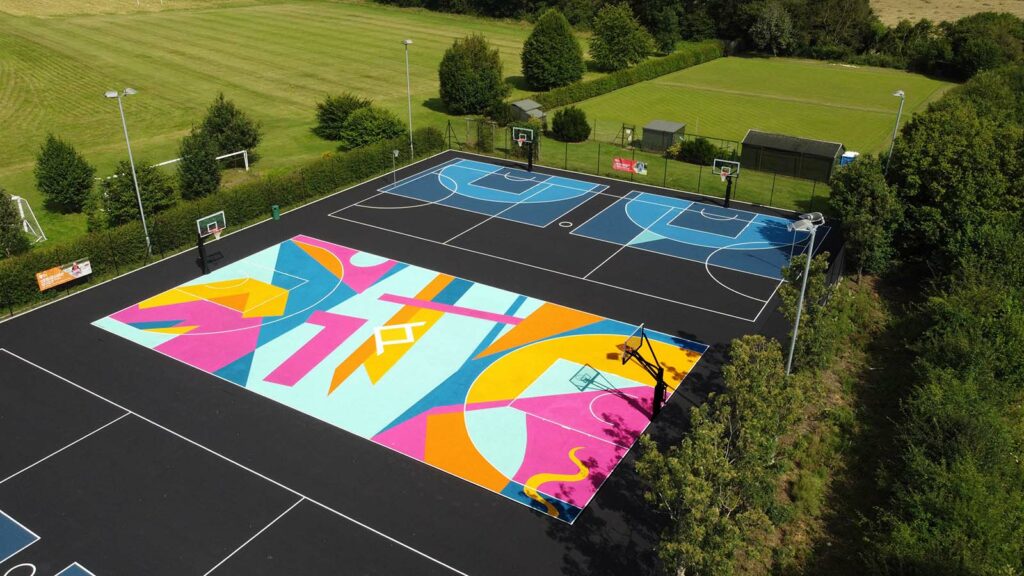
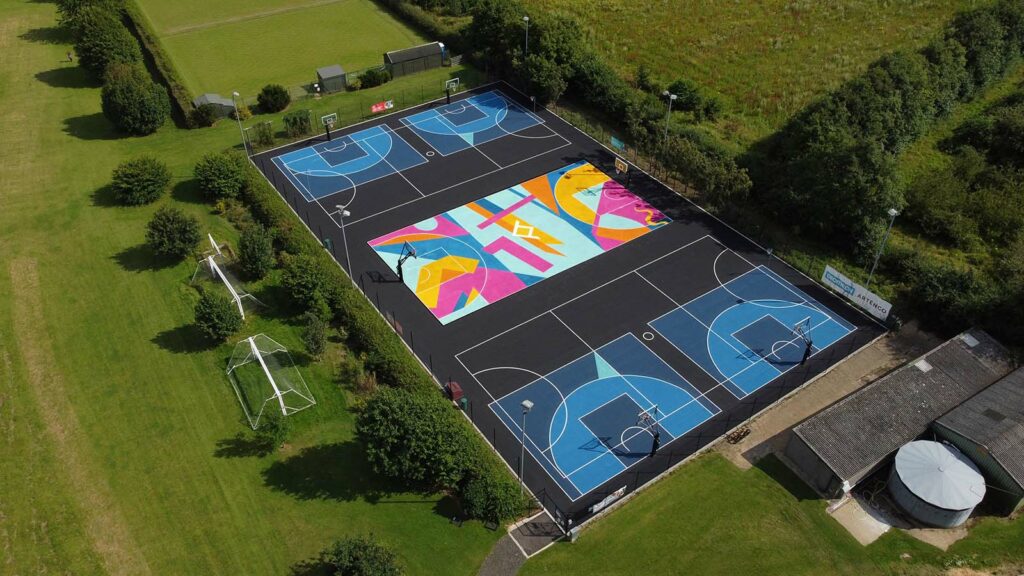
Each court at Writtle features a regulation line-marked FIBA 3×3 acrylic surface hand-painted and designed by Molly Hawkins. Molly’s contribution to the court project highlights the arts and culture relationship to sport in the UK. Molly added “My design concept focuses on how shapes and colour can create dynamic motion. The colours I chose for this piece create a clash in energy that, to me, feels really exciting and powerful. The vibrant themes of the court will, I hope, ignite passion and creativity.”
3×3 Basketball For Students, Athletes And The Local Community
Writtle University College offers ten new basketball courts in total, with four training courts on the main campus featuring the mighty Mega Slam 72 Hoops with Game Lights extending play into the night. A further six systems – including the show court – offer a spacious floodlit area for tournaments and events. It is the first institution in the UK to invest in a dedicated 3×3 facility.
WUC’s Head of Sport, Dr Greg Deacon, said: “3×3 is basketball at its most inclusive. These courts are the first of many fantastic projects that will help us to support students, athletes and the local community.”
The Olympics have introduced a new 3×3 basketball tournament comprised of eight men’s and eight women’s teams. The rules of 3×3 basketball vary from standard basketball, as games are played on a half court with only four players in total.
From Flagship Project to Practical Blueprint
The Writtle University College 3×3 courts are more than a one-off facility. They demonstrate what’s possible when space-efficient design, regulation-ready layouts and durable outdoor equipment are treated as a single system.
Rather than retrofitting informal half courts, Writtle invested in a purpose-built approach that supports training, competition and community use without compromise.
Understanding the 3×3 Format
For institutions considering a similar investment, understanding the fundamentals matters. Court dimensions, run-off allowances, surface selection and hoop specification all play a role in how well a 3×3 facility performs over time.
If you’re planning a dedicated 3×3 court, start with a clear understanding of the format itself. Our 3×3 Basketball Court Dimensions & Layout Guide explains official measurements, spacing requirements and practical planning considerations for real-world sites.
Choosing Equipment for High-Use Environments
In schools, colleges and shared-use settings, equipment choice is critical. Hoops must withstand frequent play, outdoor exposure and unsupervised use while remaining safe, stable and consistent.
The Buying Basketball Hoops for Schools guide outlines what to prioritise when specifying hoops for education and community facilities — from durability and safety to lifecycle value.
Why the MegaSlam 72 Was Specified at Writtle
For the main courts, Writtle University College specified the MegaSlam 72 hoop system to meet the demands of a high-use, outdoor 3×3 environment.
With a regulation-size backboard, in-ground installation and heavy-duty construction, the MegaSlam 72 provides the stability, ball response and durability required for both structured training and open community play. Integrated Game Lights extend usable hours without compromising safety or play quality.

Designing for Long-Term Use
Projects like Writtle show that when layout, surface and hardware are specified correctly from the outset, 3×3 basketball becomes a long-term asset rather than a temporary installation.
As the format continues to grow at grassroots, collegiate and competitive levels, facilities built with intent will define how the game is played locally for years to come.

 English (UK)
  Български
  Čeština
  Dansk
Dansk  Deutsch
  Nederlands
  Español
  Eesti
Eesti  Français
  Ελληνικά
  Hrvatski
  Magyar
  Italiano
  Latviešu valoda
  Lietuvių kalba
  Norsk bokmål
  Português
  Polski
  Română
  Српски језик
  Slovenčina
  Slovenščina
  Suomi
Suomi  Svenska
  Türkçe
  العربية
  Bosanski
  Українська