

Choosing a basketball hoop for your home court
The hoop is the one part of a court you cannot quietly change later — it is a concrete footing in a fixed position. How it mounts, how big the board should be, what "all-weather" actually demands of the steel, and which savings at the cheap end turn out to be expensive.
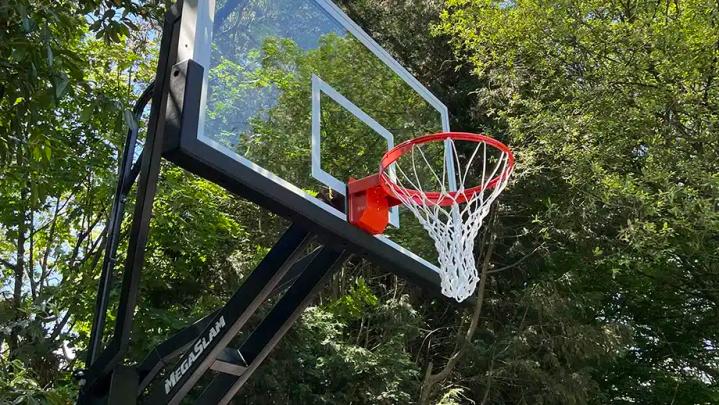
The hoop is the one part of a court you cannot quietly change your mind about later. A surface colour is a re-order. A hoop is a concrete footing in a fixed position — and on a tiled court, that footing has to be set and cured before a single tile is laid. Deciding the hoop early is what stops it becoming the thing the rest of the court has to work around.
What follows is in the order the decisions actually depend on one another: how it is mounted, how big the board is, what it is made of, and how high it sits. If you have not settled the court itself yet, start with planning a home basketball court and come back.
Portable, in-ground or wall-mounted
| Mount | Stability | From | Best for | The catch |
|---|---|---|---|---|
| Portable | Only as good as the base weight | ~£100–150 | Temporary use, rented homes, a drive that must stay clear | A full-size base takes around 50 gallons of water — "portable" stops being true |
| In-ground | Highest — no flex at the base | ~£400 | Any permanent court | Needs a concrete footing set and cured before tiles go down |
| Wall-mounted | High, if the wall is genuinely structural | Mid | Tight sites, or courts where a post would stand inside the run-off | Masonry or structural concrete only — never fence panels or timber frame |
Portable hoops, honestly
A portable hoop is stable only while its base is full. Most fill with sand, water or both, and water evaporates: a base correctly weighted in spring can be dangerously light by August. The backboard hangs all that weight out in front of the post, so an underfilled base topples forwards — which is the direction the players are standing.
If you are using one, check the fill before every session and add base gel to the water. It sets to a firm gel that resists evaporation, stops the base splitting when it freezes, and adds a little stability of its own.
In-ground
In-ground is the standard for anything permanent. The post sets into a concrete footing, typically 600 × 600 × 900 mm deep, varying with post diameter and hoop weight. Allow 48–72 hours for the concrete to cure before anything is mounted to it; assembly is then a two-to-four hour job for two people. The installation guide covers the groundwork in detail.
On a tiled court the sequence is not negotiable. The anchor goes in, the concrete cures, then the tiles are laid around it. Do it the other way and resetting the anchor means lifting the court.
Wall-mounted
Wall-mounted systems remove the post entirely, which is worth a great deal on a narrow site where a post would otherwise stand inside the run-off. They need a load-bearing masonry or structural concrete wall: a rim hang or a hard drive puts real lateral load into the fixing. Fence panels, timber-frame walls and single-skin garden walls are not candidates.
Backboard size
Backboards are sold in inches, and the size changes both how the hoop plays and how it sits against the court.
| Size | Shape | Suits | Notes |
|---|---|---|---|
| 44" | Fan | Driveways, small courts, younger players | Below this, shooting geometry changes noticeably |
| 54" | Rectangular | The most common home court size | The practical answer where space is tight |
| 60" | Rectangular | Performance home courts | Larger target area — better for real shooting practice |
| 72" | Rectangular | Regulation-equivalent, club and competition | 1.83 m wide; needs a court that can carry it |
Match the board to the court rather than to ambition. A 72-inch board on a 6 m-wide court is out of proportion and eats the run-off. For most home builds 54 or 60 inches gives a realistic rebound without a full-span regulation post. If you want the reasoning in full, the hoop dimensions guide has the measurements.
FIBA regulation is 1.80 × 1.05 m. The NBA uses 72 × 42 inches (1.83 × 1.07 m), and 72" is how the regulation-size board is sold across the UK and Europe.
Backboard material
Tempered glass is the reference. It gives the truest rebound, holds its clarity outdoors without yellowing, and at the regulation 12.7 mm (½ inch) it returns the feedback off a bank shot that makes shooting practice worth doing.
Acrylic is the sensible middle: lighter, cheaper, resistant to cracking in cold weather, but it flexes more and the ball comes back slightly differently.
Polycarbonate is the budget option. It will not shatter, but it flexes on contact and degrades under sustained sun. A flexing board also rattles — an unpleasant noise on every strike, and almost nothing for a shooter to learn from.
What "all-weather" actually means
An outdoor hoop is the most weather-exposed thing on the court, and three details separate one that lasts a decade from one rusting inside eighteen months.
Hot-dipped galvanised steel. Galvanising lays down zinc at 10 to 15 times the thickness of electroplating. That is the difference that survives years of rain and damp.
A powder coat over the galvanising. The matte black finish on professional systems is not styling — it seals against UV and gives a second barrier against corrosion.
Stainless steel fixings throughout. Bolts, net ring, bracket mounts. Dissimilar metals in contact in wet conditions corrode galvanically, and net-ring bolts are a common first failure on cheaper systems.
Nets matter more than they look. Standard nylon perishes outdoors; all-weather systems use anti-whip chain or weather-resistant polyester on a double rim, with a spring-loaded or solid anti-whip mechanism so the net does not tangle mid-game.
The alternative to all of this is bringing the hoop indoors each winter and standing it next to the telly, which rather defeats the point of a court.
Fixed or adjustable height
Regulation is 3.05 m to the top of the rim.
If children will use the court, adjustment earns its keep. It lets younger players develop a proper shooting action at 2.0–2.6 m, and the hoop grows with them instead of being replaced. Look for a hand-crank or counterbalanced mechanism that holds height without drifting — gas-assisted struts lose pressure over time and the basket creeps downward during play.
If the court is mainly for adults, fixed at 3.05 m is the better long-term choice: nothing to flex, nothing to maintain, nothing to drift.
Overhang and clearance
Overhang is the distance from the face of the backboard to the centre of the rim, and it is what keeps a player driving the basket away from the post. 80 cm is the practical minimum. Professional systems run 1.2–1.6 m, and more is always both safer and better to play on.
Before fixing a position, check:
- clear shooting arc above the hoop — no overhanging branches or eaves
- run-off behind the baseline, so a player following through has somewhere to go
- distance to walls, glazing and fences on the shooting side
- which way the court faces, and where the sun sits at the time of day it will be used
- ground conditions where the footing goes
What buying cheap actually costs
Savings at the cheap end come out of specific places, and they are all places that fail.
- Post steel. Look for at least a 3.5-inch post on an in-ground system. Thin-wall posts flex, and flex shows up as vibration on every shot.
- Safety certification. ASTM F2043 covers post strength, backboard integrity and anchor depth. Ask for explicit compliance or an equivalent EU rating — the standards are worth understanding, because a poorly anchored post is the real risk, not a scuffed board.
- Dunking. Cheap systems are not built for it. Dunk-capable means heavier steel and a proper anchor, and there is no inexpensive version of that.
- Warranty on the steel. A lifetime warranty on the framework is the clearest signal a hoop was designed for permanent outdoor installation rather than a couple of summers.
Total cost of ownership usually favours buying once. A budget hoop replaced twice costs more than the good one — and the two years in between were spent playing on something that rattled.
A short decision framework
- How permanent is this? Anything you would call a court means in-ground.
- Who plays on it now, and in five years? That answers fixed versus adjustable.
- How wide is the court? That answers backboard size, before preference does.
- How exposed is the site? Coastal and open hillside gardens want heavier galvanising and stainless throughout.
- Is the base ready? The footing has to be in and cured before tiles are laid.
Related products
Frequently asked questions
View all FAQs →More questions? Browse the full basketball court FAQ