

How to choose a court surface
There is no best surface, only the right one for where the court sits and how hard it gets used. What separates a base from a playing surface, why a covered court is still an outdoor court, and what each option actually costs you over twenty years.
Most surface guides, ours included, start by comparing products. That is the wrong end. Nearly every surface that disappoints was chosen correctly on paper and put in the wrong place: a floor built for still, dry air, installed somewhere that is neither.
Two questions settle most of it, and only one of them is about the surface.
First: is the space actually climate controlled?
Not "is there a roof". Sealed, heated, and humidity controlled, all year.
If the answer is no, you are building an outdoor court, whatever it looks like from the kitchen window. That one reclassification eliminates more bad options than any amount of product comparison, and it is the single most common mistake we see.
The covered court is the expensive version of this mistake
Carports, barns, open-sided training halls, a court under a canopy. They feel indoor. They behave outdoor.
Air still moves through them, so humidity tracks the weather outside. Temperature still swings, so the slab still expands and contracts. Condensation still forms. It is often worse than in the open, because a roof traps still, damp air against a cold floor overnight.
An indoor floor put in one of these will usually look right for a season. What follows is cupping, lifting at the edges, or a surface that goes slick in the mornings. The roof bought you shade and rain cover. It did not buy you an indoor environment.
Treat any space you cannot heat and seal as fully exposed.
Second: concrete is a base, not a surface
This is worth saying plainly because so much of the market blurs it. Concrete and asphalt are what a court is built on. They are playable (a generation grew up on them), but they offer no shock absorption at all, they send every landing straight into ankles and knees, and they crack as the ground beneath them moves.
Almost every good court has concrete in it. Almost none has concrete as its playing surface.
So the real choice is what goes on top, and there are three answers.
The three surfaces, honestly
| Surface | Cushioning | Outdoors | Renewal | Up-front cost |
|---|---|---|---|---|
| Modular tiles | Some: the tiles flex underfoot | A floating field, so it accommodates thermal movement; drains through | Replace a damaged tile on its own | Highest |
| Acrylic or resin coating | None beyond what the base already has | Follows every crack and fall beneath it | Recoat within a decade, sooner in daily use | Middle |
| Painted concrete | None | Wears fastest where you play most | Reapply every few years | Lowest |
Modular tiles
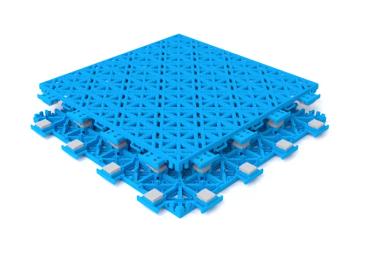
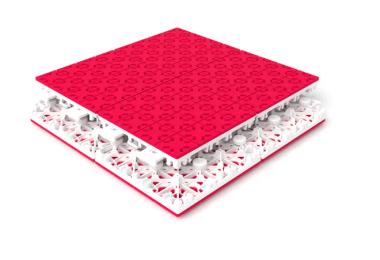
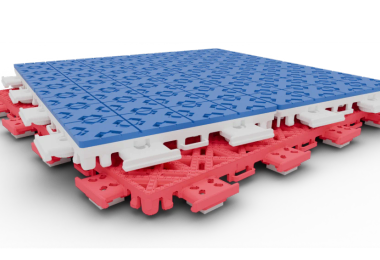
Interlocking polypropylene tiles laid over a prepared base. They flex slightly underfoot, drain through, and let air move under the court.
The properties that matter outdoors come from the format rather than the material: the tiles are laid as a floating field, so the whole surface accommodates thermal movement instead of resisting it. That is why they hold up in exposure where rigid systems fail. Grip stays predictable wet, because water leaves through the surface rather than sitting on it.
Colour is moulded into the tile, not applied to it. A colour boundary, such as a key, a surround or a second sport's zone, is a change of tile, so it lands on the tile grid and cannot fade, peel or wear off. That constraint is also why zone edges step rather than curve.
The practical advantages: you can lay it yourself on a flat base, and a damaged tile lifts out and is replaced individually without touching the rest of the court.
The honest limitations: a higher up-front cost than a coating, a genuine dependence on base flatness, and quality that varies enormously between manufacturers. A cheap tile is a different product, not a cheaper version of the same one.
Acrylic and resin coatings
Applied over sound concrete or asphalt by a contractor. Consistent ball response, clean lines, a good-looking court, and the cheapest route to a real playing surface if you already have a structurally sound slab.
The catch is that a coating inherits every fault beneath it. It follows cracks, it follows falls, and it cannot add cushioning that the base does not have. It also needs redoing: plan on recoating within the first decade, sooner on a court in daily use.
Where it wins is resurfacing. If your slab is sound and flat, a coating is the least disruptive way to make it play properly.
Painted concrete
Specialist paint on an existing slab. Cheapest of all, and it does improve grip and appearance over bare concrete.
It adds no cushioning whatsoever, and it wears in the places you use most: the key, the service boxes, the centre. Reapplication comes round every few years. That is reasonable for a driveway hoop, but it is not a surface to specify for a court people will use several times a week.
What "performance" actually means
Performance gets discussed as if it were one number. It is at least five, and they trade against each other:
- Ball response: how true and how fast the bounce comes back
- Grip: traction for cutting and stopping, wet as well as dry
- Shock absorption: what the surface takes out of a landing
- Fatigue reduction: whether an hour on it leaves you sore
- Consistency: whether any of the above holds up across seasons and years
No outdoor surface maxes all five, and any supplier claiming otherwise is selling. What changes is which ones you should be buying:
- A home court wants forgiveness and consistency. It gets played on casually, by mixed ages, often in poor light and worse weather. Ball response matters less than the surface behaving the same in November as in June.
- A club or training facility wants predictability and durability. Sessions are long, frequent, and the surface has to be the constant that lets players trust their footing.
- A school or community court wants tolerance of neglect. It will be maintained less than promised and used harder than planned. A surface that degrades gracefully beats one that performs beautifully for two years.
That last point generalises. Outdoors, a surface that tolerates being ignored will outlast a higher-maintenance one that looked better on day one.
What it costs
Surface cost varies too much by country to state usefully in one figure. Groundwork rates, VAT and delivery move the total more than the choice of tile does. The country cost guides carry real numbers.
The ranking, though, holds everywhere. Cheapest first, up front: painted concrete, then acrylic coating, then modular tiles. Reverse that ranking for cost per year of use, because lifespan and repairability run the other way. Paint is redone in a few years and a coating within a decade, while a tiled court is repaired a tile at a time rather than resurfaced.
The base sits underneath all three and is frequently the largest line on the quote regardless of which surface you pick.
Order samples before you commit
Grip, texture and colour all read differently in the hand than on a screen, and tile scale is hard to judge from photographs. People are routinely surprised by how large or small the modules are next to a court.
It is a small step that removes most of the guesswork, and it is the one thing in this guide we would insist on.
---
Next: How to build a basketball court covers the base beneath whichever surface you choose, which is the part that decides whether any of this works.
Related products
Frequently asked questions
View all FAQs →More questions? Browse the full basketball court FAQ