

Volleyball court dimensions and the free zone
A volleyball court is 18 by 9 m, but the number that decides whether you can build one is the free zone. At the FIVB minimum of 3 m all round, the total becomes 24 by 15 m, and much of the game is played out there.
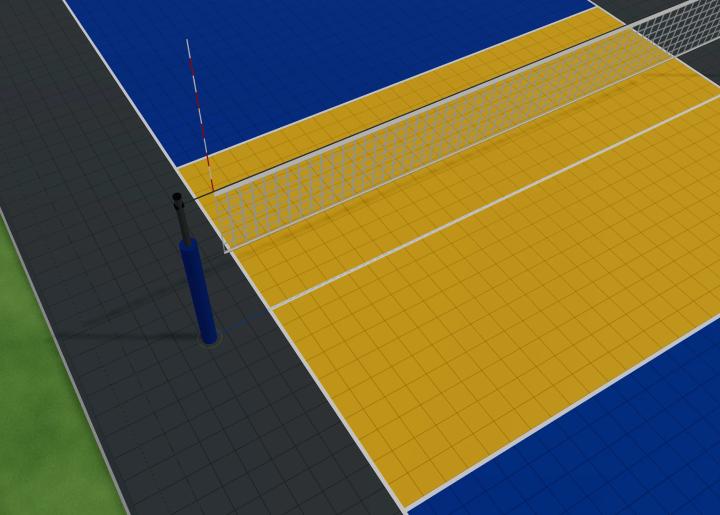
An FIVB volleyball court is 18 m by 9 m. That figure is almost never the one that matters, because volleyball is played substantially outside the court, and the space around it is a regulated part of the facility rather than a courtesy.
The free zone is the whole planning question for volleyball. Get it wrong and you have a court where a dig off the boundary line puts a player into a fence.
Official volleyball court dimensions
- Court: 18 m by 9 m, with a centre line dividing two 9 m by 9 m halves
- Attack line: 3 m from the centre line on each side
- Free zone: at least 3 m all round for FIVB play
- World and official competition: 5 m at the sides and 6.5 m at the ends
- Net height: 2.43 m for men, 2.24 m for women
Net height also steps down by age group, so a court that will be used by juniors needs posts that adjust rather than a fixed setting. This is worth resolving before buying posts, because retro-fitting adjustment is more awkward than specifying it.
What the free zone does to your footprint
At the FIVB minimum of 3 m, an 18 m by 9 m court becomes a 24 m by 15 m facility. At world competition clearance it becomes 28 m by 22 m. The court itself is a little over half of the space you need.
- Recreational: about 2 m of run-off, roughly 22 m by 13 m overall
- FIVB: the regulation 3 m free zone, 24 m by 15 m overall
- International: 5 m sides and 6.5 m ends, for major competition
A recreational court with about 2 m all round is a real and playable court for gardens, campsites and schools. It is not FIVB legal, and that is fine if nobody is refereeing. What is not fine is a court with no run-off at all, because in volleyball the player chasing the ball is going backwards and looking up.
Overhead clearance matters too. Indoors, seven metres is the usual minimum and many halls cannot give it. Outdoors this stops being a constraint, which is a genuine argument for an outdoor court.
Hard court, not sand
Indoor and outdoor volleyball on a hard floor is a different sport from beach volleyball, and the court reflects it: six players a side rather than two, an attack line that matters, and much faster movement because the floor gives back what you put into it.
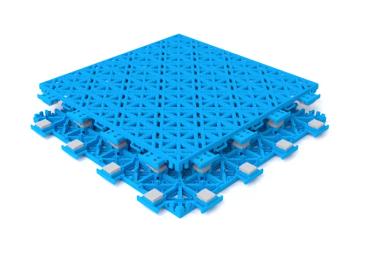
The surface has to grip for lateral movement and absorb repeated landings from blocking and spiking, which are the hardest impacts in the sport. It also has to be forgiving of a dive, because players will hit the floor at speed with forearms and hips. A cushioned modular tile over a prepared base handles both, and drains so an outdoor court is usable soon after rain.
One thing to check: whatever surface you choose, it should not be abrasive. Volleyball produces more skin contact with the floor than any other sport in this range.
Sharing the space
A volleyball court's generous free zone makes it a good candidate for a multi-sport pad, because the run-off it needs is enough to host smaller courts alongside. A 24 m by 15 m volleyball facility comfortably contains a badminton or pickleball court in the same rectangle.
Net posts are the practical complication. Volleyball posts carry a lot of tension and want proper ground sockets, so plan their positions with the base rather than adding them later.
Planning your court
Decide the free zone first and the court second, which is the reverse of how most people approach it. If you have 24 m by 15 m you have a regulation facility. If you have 22 m by 13 m you have a good recreational court. Below that, consider whether a smaller-court sport suits the space better.
The formats above are preconfigured in the OnCourt court designer, where you can set your own dimensions, see the free zone drawn to scale and get a price before groundwork.
Related products
Frequently asked questions
View all FAQs →More questions? Browse the full basketball court FAQ