

Badminton court dimensions and layout
A badminton court is 13.40 by 6.10 m, and it is the same slab a pickleball court sits on. The dimensions, the run-off the BWF asks for, and a straight answer on whether wind makes an outdoor court worth building.
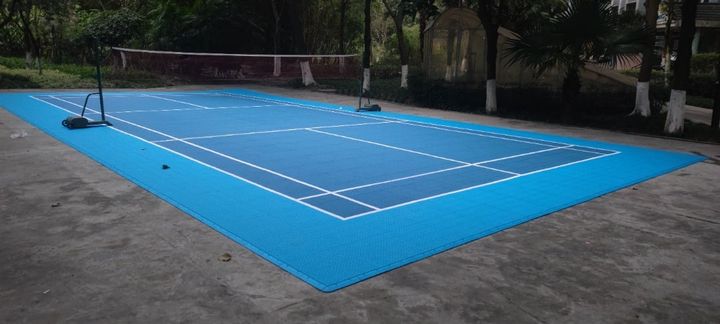
A badminton doubles court is 13.40 m by 6.10 m, which is 44 ft by 20 ft. If that sounds familiar it is because a pickleball court is exactly the same size, so one pad can carry both games.
Badminton is also the one sport in this range where the honest guide has to talk you out of something, or at least make sure you know what you are buying. A shuttlecock weighs about five grams. Wind beats it every time.
Official badminton court dimensions
The court is 13.40 m long. The width depends on the format, and unusually it is the singles court that is narrower, which is the opposite of what pickleball does.
- Doubles court: 13.40 m by 6.10 m
- Singles court: 13.40 m by 5.18 m
- Net height: 1.55 m at the posts, 1.524 m at the centre
- Short service line: 1.98 m from the net
Both sets of lines are marked on the same court, so you are not choosing between them. The singles sidelines sit inside the doubles ones, and the long service line for doubles sits inside the baseline.
How much space you need around it
The BWF recommends roughly 1.8 m at the sides and around 2.4 m behind each baseline for club play. That puts a comfortable court at about 9.7 m by 18.2 m overall.
A garden court can be tighter. Trimming to about 1 m at the sides and 1.5 m at each end brings the whole thing inside roughly 8.1 m by 16.4 m, which is a genuinely achievable footprint.
- Garden: about 8.1 m by 16.4 m, tight run-off, for family games
- Standard: about 1.2 m sides and 2.1 m ends, for recreational club play
- Comfort: the BWF recommendation, about 1.8 m sides and 2.4 m ends
- Tournament: about 2.4 m sides and 3 m ends
Indoors there is a second constraint that does not apply outdoors: BWF competition asks for up to 9 m of clear height. Outdoors you have the sky, which is the one respect in which an outdoor court is unambiguously better.
The wind problem, and when to build anyway
A shuttlecock is a drag-stabilised projectile. That is what makes the game work indoors, and it is what makes it fragile outdoors. A light breeze curves a clear. Anything more and the shuttle simply does not go where it was hit, which turns a skilful game into a lottery.
So be clear about what you are building. If the court is for serious badminton, it needs to be indoors or in a well-sheltered spot, and you should plan around that rather than hope. If it is a garden court that will be badminton on calm evenings and something else the rest of the time, it is an excellent use of the space.
Practical things that help: site the court in the lee of a building or a solid boundary, run the long axis across the prevailing wind rather than along it, and accept that a hedge does more than an open fence. Plastic shuttles are heavier than feather and hold a line better in moving air, which is why most outdoor play uses them.
Sharing a pad with pickleball
Because the footprints match exactly, one slab can carry both sports with two sets of lines and a change of net height. Pickleball plays over a 36 in net, badminton over one at 1.524 m, so you need posts that adjust or a second set.
This is the strongest argument for building the pad at all. Pickleball is unaffected by the breeze that ruins badminton, so the combination gives you a court that is always playable and sometimes both. Add a third set of lines and the same rectangle takes a junior tennis court.
Surface
Badminton is played on the balls of the feet with constant lunging and direction changes, so the surface has to grip predictably and forgive the joints. A hard, true, slightly cushioned floor is what the game wants. Grass is unplayable, and bare concrete is punishing over a long session.
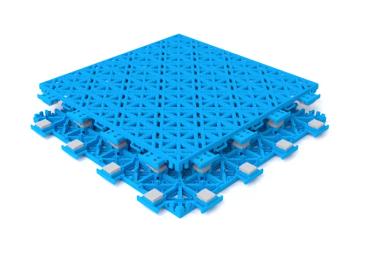
Outdoors, drainage matters as much as grip: a court that holds surface water after rain is unusable for hours afterwards, which on a British summer evening is most of the ones you wanted to play on. A modular tile floor over a prepared base drains through and is playable again quickly.
Planning your court
Measure the usable rectangle first, then decide the run-off, then see which format fits. Every size above is available as a preconfigured layout in the OnCourt court designer, where you can set your own dimensions, mark both sets of lines, choose colours and see the court with a price before any groundwork starts.
Related products
Frequently asked questions
View all FAQs →More questions? Browse the full basketball court FAQ