

Handball court dimensions and markings
An IHF handball court is 40 by 20 m, the largest in the range and beyond most sites. A 32 by 16 m youth court with every marking scaled to match is the one most schools and clubs actually build.
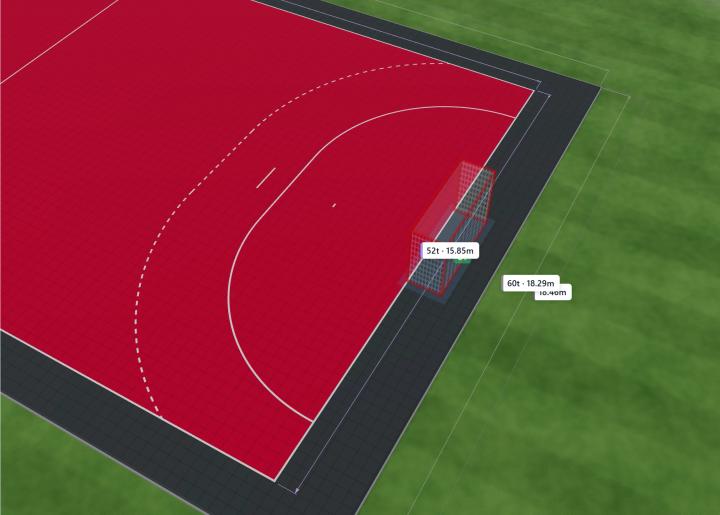
A full handball court is 40 m by 20 m. That is the largest court OnCourt builds and it is bigger than a basketball court by a considerable margin, which puts it firmly in the territory of schools, clubs and sports centres rather than domestic sites.
The useful thing to know is that a smaller court works. At 32 m by 16 m, with the markings scaled to match, it fits places the full court never will and still plays like handball.
Official handball court dimensions
- Court: 40 m by 20 m
- Goal: 3 m wide by 2 m high
- Goal area: a D shape 6 m from the goal, drawn as arcs from each post
- Free-throw line: a dashed line at 9 m
- Penalty mark: 7 m from the goal line
- Goalkeeper restraining line: 4 m from the goal
The goal area is the defining marking. It is drawn as two quarter-circles from the goalposts joined by a straight section, not as a rectangle, and no outfield player may stand inside it. The whole shape of handball comes from players jumping over that line and releasing before they land.
The 9 m line is dashed rather than solid, which distinguishes it at a glance from the 6 m line. Getting that wrong is one of the more common marking errors on multi-sport courts.
The youth court
The IHF rules define one court, 40 m by 20 m, for every age group, so a 32 m by 16 m court is a reduced court rather than an official format. Scaling every marking with it keeps the goal area, the 7 m line and the 9 m line in proportion, which is what keeps the game recognisable.
For most sites this is the realistic choice. It takes roughly two thirds of the area of a full court, which is often the difference between a project that fits and one that does not.
- IHF international: 40 m by 20 m, for clubs and competition
- Youth and school: 32 m by 16 m, the same markings at reduced scale
Run-off
Handball is fast and physical and players arrive at the sidelines at speed, frequently while airborne. A safety margin around the lines is not optional, and around 1 to 2 m at the sides with more behind each goal is a sensible minimum.
Behind the goal matters most. Shots are taken hard from close range, and both the ball and occasionally the player end up past the goal line.
Surface, and the resin question
Handball is played with constant stopping, pivoting and jumping, so the floor needs reliable grip and enough cushioning to take repeated landings. A hard, true, slightly forgiving surface is right, and outdoors it needs to drain.
There is one consideration specific to this sport. Indoor handball is commonly played with adhesive resin on the hands, and resin transfers to the ball, the floor and everything else. It is sticky, it builds up, and on some surfaces it is genuinely difficult to remove. If your court will be used for resin handball, agree a cleaning regime before the first session rather than discovering the problem later. Many clubs and most schools play resin-free for exactly this reason, and outdoor recreational handball generally does.
Sharing the court
A full handball court at 40 m by 20 m is large enough to contain most other courts in this range, which makes it an efficient base for a multi-sport facility. A basketball court fits inside it comfortably, as does a futsal pitch at international size.
If you are building at this scale, it is worth planning the line sets together rather than adding sports later. Handball's dashed 9 m line and D-shaped goal area are distinctive enough not to be confused with other markings, which helps keep a busy court readable.
Planning your court
Decide between the full and youth formats based on the site rather than ambition, since a youth court with proper run-off is a better facility than a full court squeezed to the fence. Both are preconfigured in the OnCourt court designer, where you can set your own dimensions, see the goal areas drawn correctly and get a price before groundwork.
Related products
Frequently asked questions
View all FAQs →More questions? Browse the full basketball court FAQ