

Tennis court dimensions, and what fits in a garden
A full tennis court needs about 36.6 by 18.3 m once you include the run-off, which is why most gardens cannot take one. The ITF stage courts are the useful answer, and the smallest is about the size of a badminton court.
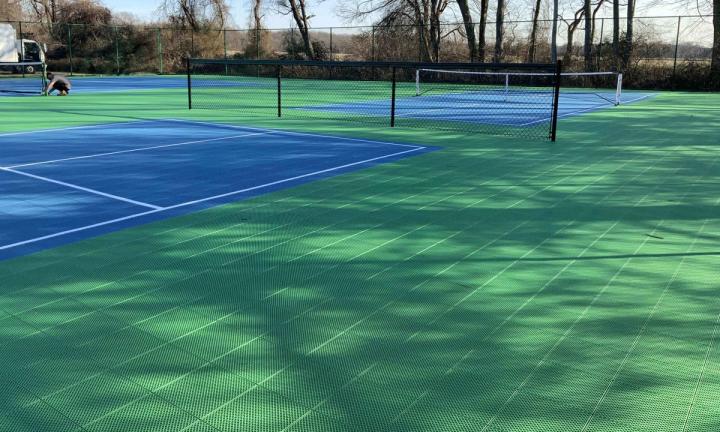
A tennis court is 23.77 m by 10.97 m for doubles. That is not the number that decides whether you can have one. The number that decides it is about 36.6 m by 18.3 m, which is the court plus the run-off you need to actually play, and it is why most people asking about a home tennis court cannot have a full one.
That is worth saying plainly at the start, because the useful part of this guide is what you can build instead. It is not a compromise invented for small gardens. It is the same set of courts the ITF and the LTA teach the game on.
Official tennis court dimensions
- Doubles court: 23.77 m by 10.97 m
- Singles court: 23.77 m by 8.23 m
- Net: 1.07 m at the posts, 0.914 m at the centre
- Service line: 6.40 m from the net
Both sets of lines live on one court, with the singles sidelines inside the doubles ones. The net dips 15 cm in the middle, which is a bigger difference than it looks and changes what clears down the centre.
The run-off is the real constraint
The ITF recommends about 3.66 m at the sides and 6.40 m behind each baseline. Add that to the court and you need roughly 36.6 m by 18.3 m, about 670 square metres of flat, clear ground.
For scale, that is around three times the area a pickleball court needs and roughly the footprint of four pickleball courts side by side. Very few domestic gardens have it, and the ones that do usually cannot give it the flatness a tennis court wants.
You cannot trim tennis run-off the way you can trim it for a smaller-court sport, because the run-off is where the game is played. A baseline rally in tennis happens several metres behind the baseline. Cut it and you are not playing a smaller version of tennis, you are playing a different and worse game.
The stage courts, which is what actually fits
The ITF Play and Stay pathway defines three smaller courts, each with its own ball pressure, and they are the standard way children learn. They are also the honest answer for a garden.
- Red: 10.97 m by 5.49 m, for ages 5 to 8. Roughly the size of a badminton court.
- Orange: 18.29 m by 6.40 m, for ages 8 to 10.
- Green: 23.77 m by 8.23 m, full length at singles width, for ages 9 to 11 and above.
A red court fits in a space that would never take a full court, and it is a real court with real lines and a lower-pressure ball that behaves properly at that size. A green court is full length, so it teaches the actual distances while asking for singles width rather than doubles.
There is also a combined layout that carries a full regulation court with four red courts marked inside it. One pad, the whole pathway, and four children rallying at once instead of two waiting.
What the surface has to do
Tennis punishes an uneven floor more than most sports because the ball arrives fast and low and any inconsistency shows in the bounce. Flatness tolerance matters more here than anywhere else in the range.
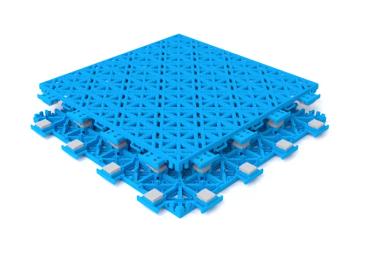
It also needs to drain. An outdoor court that stays wet is out of use for hours after rain, and standing water on a hard surface is genuinely dangerous at tennis speeds. A modular tile floor drains through rather than off, which is why it recovers quickly.
Fencing is effectively part of the court rather than an extra. A tennis ball leaves the playing area frequently and at speed, so unless the court sits inside a large enclosed space you will want containment on at least the two ends.
Deciding what to build
Measure the usable rectangle honestly, including whether it is genuinely flat. If you have 36 m by 18 m, build the full court. If you have 25 m by 12 m, a green or orange court is a real tennis court and a full one never will be. If you have less, a red court still teaches the game and fits alongside other sports on the same pad.
Every one of these layouts is preconfigured in the OnCourt court designer, so you can set your own dimensions and see which stage the space actually supports before committing to groundwork.
Related products
Frequently asked questions
View all FAQs →More questions? Browse the full basketball court FAQ