

Pickleball court dimensions and layout
A pickleball court is 20 ft by 44 ft, the same for singles and doubles, and it needs less than a third of the space a tennis court does. What that means for a real garden, why the kitchen sets how the game plays, and a straight answer on the noise.
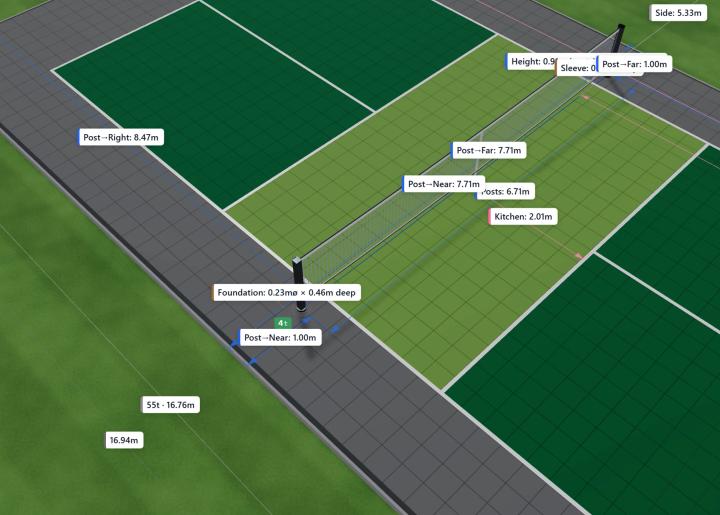
A pickleball court is 20 ft by 44 ft. That is the whole reason this guide exists: it is small enough to build in a garden that could never take a tennis court, and it is the same size whether you play singles or doubles.
The numbers below are USA Pickleball's, and they are the same figures the OnCourt court builder uses, so what you read here is what you will get when you lay one out.
Official pickleball court dimensions
The playing surface is 20 ft by 44 ft (6.10 m by 13.41 m), measured to the outside of the lines. Unlike tennis, the court does not narrow for singles. One set of lines covers both formats, which is part of why the sport is easy to put in a domestic space.
- Court: 20 ft by 44 ft (6.10 m by 13.41 m)
- Non-volley zone: 7 ft from the net on each side
- Service areas: 10 ft by 15 ft, two per side
- Net: 36 in at the sidelines, 34 in at the centre
The net dipping in the middle is deliberate and it matters more than it sounds. Two inches of sag is enough to change which shots clear down the centre, so it is worth setting properly rather than pulling the tape flat.
The kitchen is the geometry that matters
The non-volley zone, universally called the kitchen, runs 7 ft back from the net on both sides. You cannot volley while standing in it. Fourteen of the court's 44 ft are therefore a zone where the ball has to bounce first.
This is what makes pickleball play the way it does, and it is what a court layout has to get right. Mark the kitchen wrong and the game changes character: too shallow and it becomes a game of net smashes, too deep and the rallies never come forward. It is also why the kitchen is usually laid in a contrasting colour. Players need to see the line without looking down.
How much space you actually need
The court is 20 ft by 44 ft, but nobody plays inside a box with no room to move. USA Pickleball's recommended minimum total playing area is 30 ft by 60 ft (9.14 m by 18.29 m), which gives roughly 1.5 m at the sides and 2.4 m behind each baseline. For a new build or anything competitive the recommended size is 34 ft by 64 ft (10.36 m by 19.51 m).
In a garden you can go tighter. Trimming the run-off to about 1 m at the sides and 1.5 m at each end puts the whole thing inside roughly 8.1 m by 16.4 m. That is a real back garden, and it is the single biggest difference between pickleball and every other racket sport in this range.
For comparison: a tennis court needs something in the region of 36 m by 18 m to be properly playable. Pickleball asks for less than a third of the area.
- Garden: about 8.1 m by 16.4 m, tight run-off, for relaxed games
- Standard: 9.14 m by 18.29 m, the recommended minimum
- Comfort: 10.36 m by 19.51 m, for new builds and club play
- Tournament: generous run-off, with room for a referee's chair and spectators
Whichever you pick, plan the run-off before the court. It is the part people cut first and regret, because a baseline 1 m from a fence turns every deep return into a collision.
The noise question, honestly
Pickleball is loud in a way tennis is not. A hard paddle striking a rigid plastic ball produces a sharp, repetitive crack, and it carries. In the United States, where residential pickleball arrived first, noise complaints have led to courts being restricted and in some cases removed. If your court will sit near a boundary, this is the thing to think about before the surface, the colour or the net.
What genuinely helps:
- Distance. Sound falls away quickly, so metres from the boundary are worth more than any other mitigation.
- Orientation. Point the long axis away from the nearest neighbouring house where the plot allows it.
- A solid barrier. A close-boarded fence or dense hedge on the affected side does more than an open mesh fence.
- Quieter equipment. Paddles and balls vary a lot, and some are specifically made to reduce the strike noise.
None of that makes a court silent. If your garden is small and your neighbours are close, it is better to know that at the planning stage than after the base is poured. In the UK a domestic court is usually permitted development, but noise is a separate matter from planning and a statutory nuisance complaint does not care that you had permission.
What the surface has to do
A pickleball ball is light, perforated and low-bouncing, which leaves nowhere for a poor surface to hide. Any unevenness shows up immediately as a dead or unpredictable bounce, and because rallies are played from a standing position rather than a run, players feel the floor through their feet far more than in tennis.
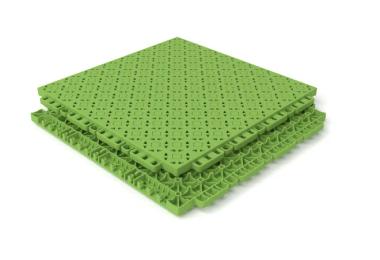
So the surface needs to be flat, consistent and hard enough to give a true bounce, while still offering some give underfoot. Grass and sand-filled turf are out. Bare concrete works but is punishing to play on for an hour. A modular tile floor over a prepared base is the usual answer for an outdoor court: it drains, it stays consistent through the seasons, and it takes the edge off the impact without deadening the ball. OnCourt's Pickleball Pro is the tile made for exactly this: a 305 mm outdoor tile with a tighter surface pattern than the general multi-sport tiles, which is what gives the ball a predictable bounce.
Colour matters more here than in most sports. The ball is usually bright yellow or green, so the court needs to contrast with it, and the kitchen needs to contrast with the rest of the court.
One court, two sports
A badminton doubles court is also 20 ft by 44 ft. The footprints are identical, so a single pad can carry both games with two sets of lines and a change of net height, which is 36 in for pickleball and just over 5 ft for badminton.
Worth knowing before you commit to a layout, because the marginal cost of the second set of lines is small and the marginal cost of a second court is not. The honest caveat is that outdoor badminton is compromised by wind in a way pickleball is not: a shuttlecock is light enough that a moderate breeze ends the game. If your plot is exposed, treat badminton as a bonus for calm evenings rather than the reason to build.
More than one court
For clubs, schools and councils, courts sit side by side on a shared pad with a walkway of about 2.4 m between them. Two courts fit in 18.29 m by 19.51 m, three in 26.82 m by 19.51 m, and four in 35.36 m by 19.51 m.
Four side by side is roughly the footprint of one tennis court, which is exactly how a lot of clubs have made the switch: one under-used tennis court becomes four pickleball courts and a fourfold increase in how many people can play at once.
Planning your court
Start with the space you actually have, not the court you want. Measure the usable rectangle, take off the run-off, and see which of the four formats fits. If the answer is the garden format, that is a real court and it plays properly. If nothing fits, a smaller practice area with a single service box is still worth having.
Every size above is available as a preconfigured layout in the OnCourt court designer, so you can set the dimensions to your own measurements, apply the kitchen and service lines, choose colours and see the finished court with a price before committing to any groundwork.
Related products
Frequently asked questions
View all FAQs →More questions? Browse the full basketball court FAQ