

Replacing a damaged tile
One damaged tile is one tile, not a patched court. It lifts out and a new one clips in, usually without tools. The catch is colour: batches vary slightly, so the time to buy spares is with the original order.
This is the argument for a modular floor that nobody makes until something goes wrong. On a poured or coated surface, damage in one spot means a repair you can see for the rest of the court's life. On a tiled floor it means replacing a tile.
What actually damages a tile
Not play. Basketball, whatever the shoes, is not what breaks these. The things that do are almost all avoidable.
- Point loads. A dragged bench leg or a loaded barrow wheel concentrates weight on a small area, where the same weight rolling on wide wheels would not.
- Heat. A barbecue, a fire pit or a chiminea on the court will deform polypropylene long before it looks dangerous.
- Cutting. Anything done on the court with an angle grinder or a saw, usually during a nearby building job.
- Ground movement. If the base settles unevenly, the tile above the low spot takes stress it was not designed for. That is a base problem showing up as a tile problem.
Swapping a tile
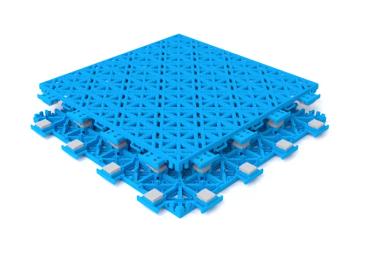
The tiles interlock with tabs and loops. To free one you disengage it from its neighbours, which for most systems means lifting one edge to release the joints rather than pulling straight up.
Work from the nearest edge of the court where you can. Tiles in the middle of a field are held on all four sides, so it is usually quicker to release a short run from the perimeter inwards than to fight a single tile in place.
The replacement clips in the same way. There is no adhesive, no curing time and no reason to keep off it afterwards.
The colour problem, and why spares are ordered upfront
Colour is moulded into the tile rather than painted on, which is what stops a court fading patchily. The side effect is that colour is set by the batch, and batches made months or years apart can differ slightly.
A single replacement in the middle of a large field of one colour can therefore be visible, particularly on a court that has had a few years of sun. The fix is boring and effective: order a small quantity of spares with the original court and keep them somewhere dry. A handful of tiles per colour is enough, costs very little at the time, and removes the problem permanently.
If you did not, and the difference bothers you, moving the mismatched tile to a less conspicuous position and putting the new one where the old one was is usually easier than it sounds.
Tiles with markings on them
Where a line crosses the damaged tile, the replacement needs the same line segment. This is worth mentioning to whoever supplies the spare, because a plain tile in the middle of a keyway line is more obvious than a slight colour difference ever would be.
When it is not the tile
If tiles keep lifting or cracking in the same area, replacing them repeatedly is treating a symptom. Recurring damage in one spot almost always means the base below has settled, holds water, or was never flat enough there. Lift a few tiles and look before ordering more.
Related products
Frequently asked questions
View all FAQs →More questions? Browse the full basketball court FAQ