

Looking after a modular court
A tiled court asks for less than almost any other surface. Sweep it, wash it occasionally, keep the joints clear, and it will look the same in ten years. Here is the short list of what genuinely matters.
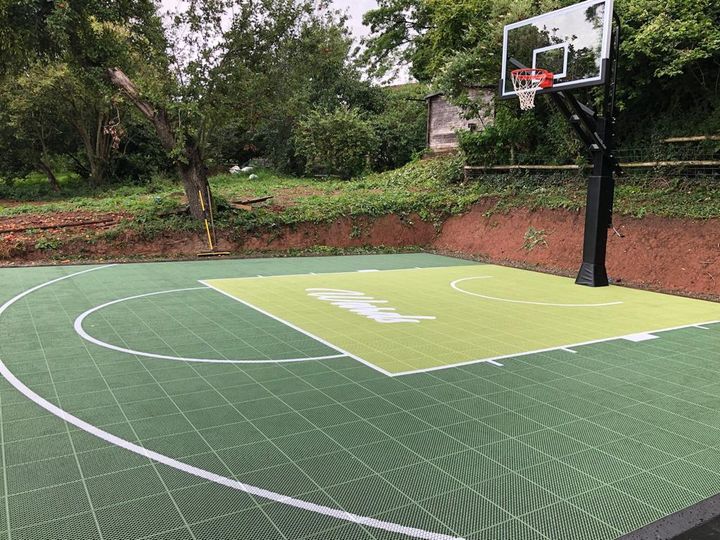
The honest answer is that a modular tile court needs very little. There is no seal coat to renew, no infill to brush back, no line paint to repaint every few seasons. Most owners do nothing for months and the court is fine.
What follows is the whole job, and it is shorter than the list for almost any alternative surface.
Sweeping, and why it is the main task
Tiles drain through their own surface, which is what keeps the court playable minutes after rain. That only works while the holes are clear. Leaves, grass clippings, blossom and moss are what block them, so sweeping is not cosmetic, it is drainage maintenance.
A stiff broom or a leaf blower does it. Under trees you will want to do it through autumn; in an open garden, a few times a year is plenty. If water starts sitting on the surface after rain, that is the court telling you the holes are blocked rather than anything being wrong with it.
Washing
A hose and a stiff brush handle most of it. For a court that has gone green in a damp corner, a pressure washer on a wide fan at moderate pressure lifts algae without trouble. Keep the lance moving and do not hold it close to a line marking.
Two things to avoid. Solvent-based cleaners can attack polypropylene, so household detergent is the right choice. And wire brushes will scuff both the tile texture and the paint, which is a permanent change for a cosmetic problem.
Moss and algae
In a shaded, damp position, green growth is the most common complaint and it is a siting problem rather than a surface one. It grows in the joints, where moisture sits longest.
A proprietary patio or artificial-grass moss treatment works, applied to a dry court and rinsed after the stated time. Better still, cut back whatever is keeping the court in shade. A court that gets a few hours of direct sun rarely has the problem at all.
What to check once a year
- Walk the perimeter and look for tiles that have lifted at a corner, which usually means something under the base has moved
- Check the ramp edging is still seated, since that is what takes knocks from mowers and wheelbarrows
- Look at where water leaves the court and clear anything that has silted up
- On an in-ground hoop, check the fixings and the padding
What not to do
Do not seal a tiled court. Sealing a surface designed to drain through is the one intervention that genuinely damages it, and the effect is not reversible without lifting tiles.
Do not drag heavy items across it. Point loads from a dragged bench or a loaded barrow can crack a tile where rolling the same weight would not.
And do not paint it. The colours are moulded into the tiles rather than applied on top, which is why they do not fade to a patchy finish the way a painted court does. Paint on top defeats the reason the surface lasts.
If something does go wrong
A damaged tile lifts out and a new one clips in, usually in minutes and without tools. That is the practical advantage of a modular floor over a poured one, where the equivalent repair is a visible patch. Keeping a few spare tiles from the original order is worth doing at the time, because colour batches vary slightly.
Related products
Frequently asked questions
View all FAQs →More questions? Browse the full basketball court FAQ