

Futsal court dimensions and surface
FIFA futsal pitches run from 25 by 16 m up to 40 by 20 m. Futsal is the one sport here that a hard, true floor genuinely improves rather than compromises, because the ball is designed not to bounce.
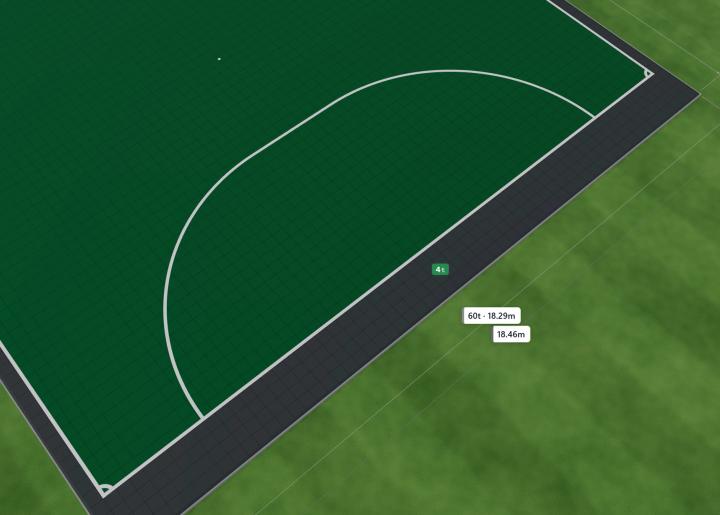
A FIFA futsal pitch is between 25 m by 16 m and 42 m by 25 m, with 40 m by 20 m the standard for international competition. Those are large numbers, but futsal scales down better than almost anything else in this range, because the game is about touch in tight space.
It is also the one sport here where a hard modular floor is not a compromise on grass. It is the correct surface, and the sport was designed around it.
Official futsal pitch dimensions
- International: 40 m by 20 m
- FIFA minimum: 25 m by 16 m
- Goal: 3 m wide by 2 m high
- Goal area: a 6 m quarter-circle from each goal post, joined across
- Second penalty mark: 10 m from the goal line
The goal area is drawn as two quarter-circles rather than a rectangle, which is why a futsal pitch cannot simply be a scaled five-a-side pitch with different lines. The shape changes where the keeper can handle the ball.
Why the surface is the point
A futsal ball is smaller than a football and deliberately low-bounce, usually rebounding to around a third of the height of a size 5 ball. That is the defining equipment choice of the sport and it only works on a hard, true, consistent floor.
On grass a low-bounce ball is dead. On an uneven surface it is unpredictable in a game built on close control at speed. So the floor is not a background decision here, it is the thing that makes futsal futsal, and a flat tiled surface over a properly prepared base gives exactly the behaviour the ball was designed for.
Grip matters as much as trueness. Futsal is played in flat-soled shoes with constant stopping and turning, so the surface has to release the foot predictably. Too much grip and players' knees take it, too little and nobody can turn.
Garden pitches
Futsal scales down further than the other sports here because a small pitch still gives a real game. Two against two on 8 m by 4 m is genuinely worthwhile practice, which is not true of, say, two against two on a quarter of a netball court.
- About 8 m by 4 m: one against one and two against two, fits a yard
- About 12 m by 6 m: three a side
- About 18 m by 9 m: four a side, the group garden format
- About 24 m by 12 m: close to half a full pitch
At these sizes the markings simplify to a centre line, a centre circle and a goal area, which keeps a small pitch readable rather than covering it in lines that mean nothing at that scale.
Containment
Futsal is played with the ball in play far more of the time than football, and the ball leaves the pitch fast and low rather than high. Rebound boards or a low solid barrier keep the game flowing and stop the ball reaching a flower bed every ninety seconds.
For a garden pitch this is often more valuable than extra size. A 12 m by 6 m pitch with rebound boards plays better than an 18 m by 9 m pitch where the ball is out every other touch.
Futsal or five-a-side
They are not the same thing, and it is worth deciding which you are building. Futsal is a codified FIFA sport with a low-bounce ball, no walls in the official game, and its own laws. Five-a-side is a format, usually played with a normal ball, often with rebound walls, and with local rules.
If you want to train touch and close control, or your children play futsal at a club, build futsal and mark it properly. If you want a kickabout pitch for friends, five-a-side dimensions and rebound boards will serve you better.
Planning your pitch
Measure the usable rectangle, decide whether you want containment, and pick the largest pitch that leaves room for it. Every size above is preconfigured in the OnCourt court designer, so you can set your own dimensions, place the goal areas correctly and see a price before groundwork.
Related products
Frequently asked questions
View all FAQs →More questions? Browse the full basketball court FAQ