

5-a-side football pitch dimensions
Five-a-side pitches usually run between about 26 by 16 m and 40 by 24 m, and there is no single governing dimension. What decides the right one is how many players, how much containment, and whether you actually want futsal instead.
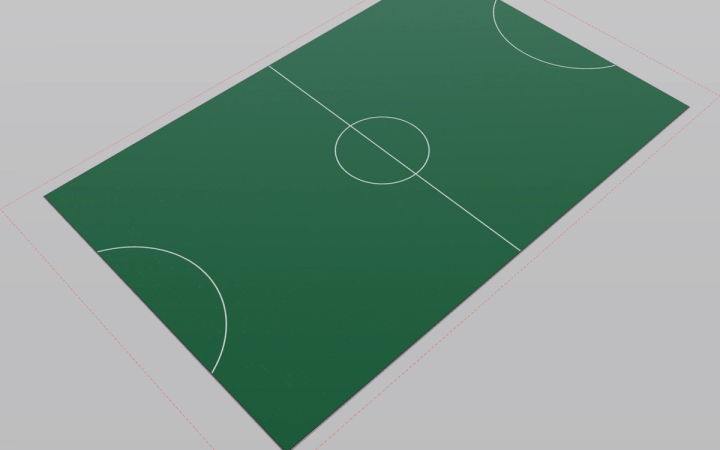
Five-a-side does not have one official size the way futsal does. It is a format rather than a codified sport, so pitch dimensions vary between leagues, centres and countries. In practice most pitches sit between about 26 m by 16 m and 40 m by 24 m.
That flexibility is useful, because it means the pitch can fit the space rather than the space having to fit the pitch.
Typical pitch sizes
- About 26 m by 16 m: compact, for urban spaces, school yards and MUGAs
- About 32 m by 20 m: the size used by most commercial five-a-side centres
- About 40 m by 24 m: a more open game, and enough for six a side
The commercial centre size is the one most people have actually played on, so it is the safest default if you want a pitch that feels familiar. The compact size is the one that fits real sites.
Markings are simple: a halfway line, a centre circle and a penalty area at each end. Some formats add a keeper-only area and a no-entry zone in front of the goal, which is worth deciding before marking rather than after.
Five-a-side or futsal
Worth settling early, because it changes the pitch. Futsal is a FIFA sport with fixed dimensions, its own laws, a low-bounce ball and no walls in the official game. Five-a-side is a format, usually with a normal ball, often with rebound boards, and with rules that vary by venue.
If children play futsal at a club, or you want to train close control, build futsal and mark it properly. If you want a pitch for adult games with friends, five-a-side is the more forgiving choice and the rebound boards will get more use than regulation markings.
The pitches are similar enough in size that one pad can often carry both sets of lines, which is worth considering if the answer is genuinely both.
Containment does more than size
On a small pitch the ball goes out constantly, and every retrieval kills the game. Rebound boards or a low solid barrier around the perimeter are usually a better investment than several extra metres of pitch, because they keep the ball in play and let a smaller pitch play faster than a larger open one.
If the pitch backs onto a boundary, a higher fence or net behind each goal saves both the neighbours and the balls. Shots in five-a-side go high more often than in futsal because the ball bounces properly.
Surface
A tiled hard surface plays differently from the sand-filled artificial grass most commercial centres use. The ball runs faster and truer, which suits a technical game, and it does not need infill topping up or brushing.
For an outdoor pitch the drainage is the decisive advantage. A free-draining tiled pad is playable soon after rain, where grass and some artificial surfaces are not, and it stays consistent through winter rather than becoming a bog at one end.
Footwear matters on a hard surface. Studs are wrong and will damage both the player and the floor, so flat-soled or moulded trainers are the right choice, and it is worth saying so to anyone using the pitch.
Planning your pitch
Start with the usable rectangle and decide on containment before pitch size, since the barrier takes space and changes what fits. Then pick the largest of the three formats that leaves room for it.
All three are preconfigured in the OnCourt court designer, so you can set your own dimensions, place the penalty areas and see a price before any groundwork.
Related products
Frequently asked questions
View all FAQs →More questions? Browse the full basketball court FAQ