

Fencing and keeping the ball in
Most home courts do not need fencing all the way round. They need it in one or two directions, at a height set by what is behind them. And anything over 2 m usually needs planning permission, which is where this gets expensive.
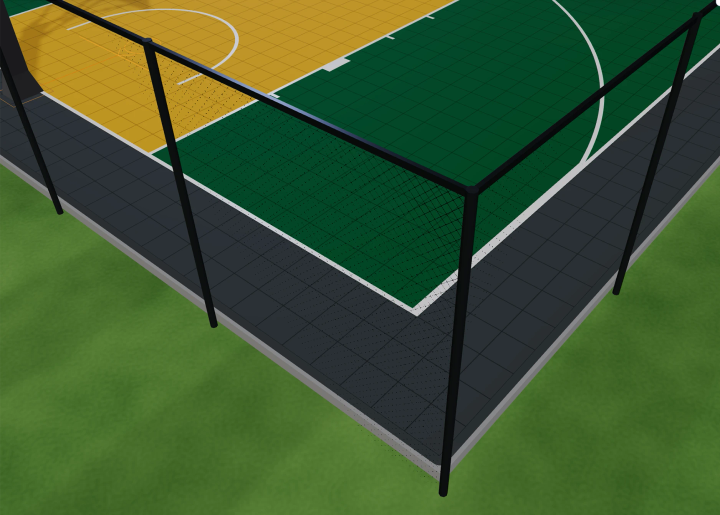
Ball containment is the thing people budget for last and regret first. A court that sends a ball into a neighbour's garden every few minutes stops being used, and the fix after the fact costs more than it would have during the build.
The planning figures in this guide are general information, not planning advice. The 2 m threshold described is the usual position in England; the other UK nations differ, and rights can be restricted at a specific address. Your local planning authority is the body to confirm with, and it is a much cheaper conversation before the court is built than after.
It is also the part most likely to need planning permission, which makes it worth deciding early rather than adding later.
You probably do not need it all the way round
Full enclosure is a club solution. At home, balls leave a basketball court in predictable directions: behind the hoop, and to the sides at the hoop end. The far end sees far less.
So the useful question is not how high a fence should be, but which directions actually need one. A single high panel behind the hoop and partial returns down the sides handles most of it, costs a fraction of full enclosure, and looks considerably less like a cage.
How high
Height is set by what is behind the court rather than by the sport.
- Open ground or your own garden beyond: often nothing at all, or a low barrier to stop the ball rolling
- A boundary with a neighbour: around 3 m behind the hoop is the usual answer
- A road, water, or a greenhouse: higher, and this is the case where full enclosure at one end earns its cost
- A slope running away from the court: height helps less than you would think, since the ball leaves at speed. Catch it low and close instead
The 2 m planning threshold
In the UK a fence over 2 m generally needs planning permission, and a court fence is exactly the kind of structure that exceeds it. This catches people out because the court itself is usually permitted development while the fence around it is not.
Adjoining a highway the threshold drops to 1 m. Conservation areas and listed properties have their own rules, and a covenant on the deeds can restrict height regardless of what the council allows.
Practical consequence: if you want a 3 m fence, that is a planning conversation rather than a shopping decision. It is much easier to have it alongside the rest of the project than as an afterthought once the court is in and the balls are going over.
Fence, net, or rebound
Three different answers to the same problem.
Mesh fencing is the durable choice and the most visually present. Welded mesh panels are rigid enough to rebound a ball, which players either like or find annoying depending on the game.
Netting on posts is cheaper, far less visible, and absorbs the ball rather than returning it. It is the right answer where you want containment without a structure dominating the garden, and it comes down in winter if you want it to.
Rebound boards at low level along a side turn containment into part of the game, which is why they suit futsal and five-a-side more than basketball. They keep the ball live rather than stopping it.
Wind, which decides more than people expect
A fence is a sail. Solid panels and fine mesh catch wind and put real load into the posts and their foundations, which is why a fence built to a garden-fence specification blows over and a court fence needs proper footings.
Open mesh passes wind, which is one of the reasons it is the standard for sports enclosures despite being the least attractive. On an exposed site this stops being an aesthetic decision.
Deciding
Work out which directions genuinely need containment, what is behind them, and whether the height that implies crosses the planning threshold. Then price it as part of the court rather than after it, because the groundwork for fence posts is far cheaper while there is already a machine on site.
Frequently asked questions
View all FAQs →More questions? Browse the full basketball court FAQ