

Netball court dimensions and markings
A netball court is 30.5 by 15.25 m, divided into three thirds, with a goal circle of 4.9 m radius at each end. The post carries no backboard and stands on the goal line, which is the detail people coming from basketball get wrong.
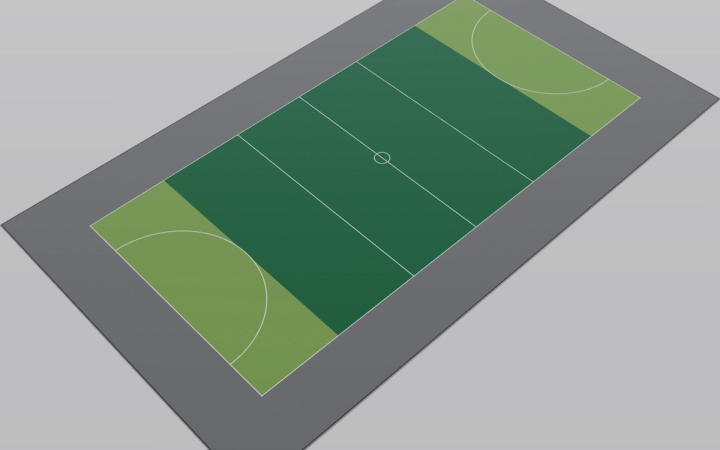
A full netball court is 30.5 m by 15.25 m, which is 100 ft by 50 ft. It is a big court, wider than a basketball court and almost as long, and the full size is out of reach for most domestic spaces.
The more interesting thing about netball is that people who know basketball assume they know netball, and the two differ in ways that change how the court is built.
Official netball court dimensions
These are World Netball's figures.
- Court: 30.5 m by 15.25 m
- Thirds: three equal sections of about 10.17 m each
- Goal circle: a semi-circle of 4.9 m radius, centred on the middle of the goal line
- Centre circle: 0.9 m diameter
- Goal post: 3.05 m high, with a ring of 380 mm internal diameter
- Clearance: 3.05 m between the court lines and the surround
The goal circle is defined by a radius, not a diameter. Several widely-copied sources give it as a 4.9 m diameter, which halves the shooting area and produces a court nobody can play on. Take it from World Netball.
What basketball players get wrong
Three differences matter when you are marking out a court.
There is no backboard. The ring is mounted on a bare post, so there is no rebound off a board and shots have to be clean. It also means the shooting geometry is completely different: a netball shot has no forgiving surface behind it.
The post stands on the goal line, not behind it. Play happens around the post rather than in front of it, and a player can be positioned behind it. That is why the 3.05 m clearance behind the goal line is a real requirement rather than a nicety.
And the thirds govern everything. Players are restricted to specific areas by position, and the ball must be touched in each third as it moves up the court. The lines are not decorative, so a court with vague or missing third lines is not a netball court.
Sizes that actually fit
Full size needs 30.5 m by 15.25 m plus the clearance, which puts the total near 36.6 m by 21.4 m. That is a club or school facility, not a garden.
- Intro: about 16 m by 8 m, for primary school and beginners, with the thirds and circles scaled
- School: about 24 m by 12 m, sized for a school sports hall
- Club: about 28 m by 14 m, close to international, for training and regional play
- International: the full 30.5 m by 15.25 m with 3.05 m run-off all round
Scaled courts keep the markings that make the game work, the three thirds and the goal circles, at proportions that suit the smaller court. That matters more in netball than in most sports, because the geometry of the thirds is the game.
Sharing with basketball
A netball ring and a basketball ring are both at 3.05 m, which makes a combined court a genuine option and is why so many school courts carry both sets of lines. The catch is the post position: netball posts stand on the goal line and basketball posts stand behind the baseline with the backboard overhanging.
In practice that means either sockets for removable netball posts, or accepting a permanent post that sits inside the basketball playing area. Neither is difficult, but it is a decision to make before the base is laid rather than after.
Surface
Netball involves hard stops. The footwork rule means a player receiving at speed has to land and stop rather than run on, and it does that repeatedly for an hour. Grip and shock absorption matter more than in sports where players decelerate gradually, and knee and ankle injuries are the sport's characteristic problem.
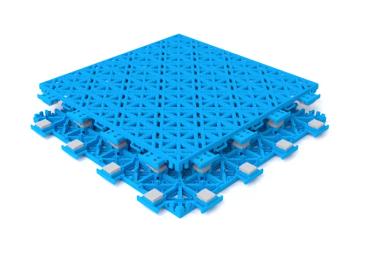
So the floor should grip consistently when dry and drain quickly when wet, with enough give to take the edge off the landing. Outdoors, a modular tile surface over a prepared base does both, and stays consistent through the seasons in a way a painted macadam court does not.
Planning your court
Start from the space and pick the largest format that fits with its run-off, rather than squeezing a full court in without clearance. Every size above is preconfigured in the OnCourt court designer, where you can set your own dimensions, see the thirds and goal circles laid out properly, and get a price before groundwork.
Related products
Frequently asked questions
View all FAQs →More questions? Browse the full basketball court FAQ