

Do You Need a Building Permit for a Basketball Court in Your Garden in Germany?
In most cases a garden court in Germany needs no Baugenehmigung. The exceptions are where it gets specific: fence heights that vary by state, floodlighting, conservation areas, and whether your surface counts as Versiegelung.
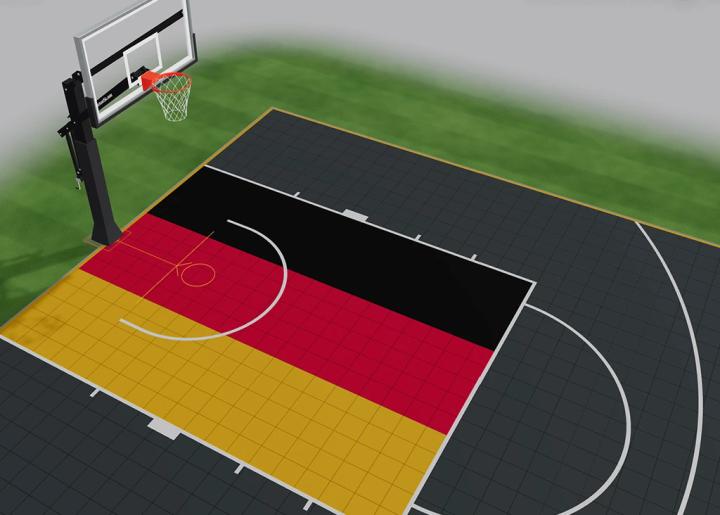
Do You Need a Building Permit for a Basketball Court in Your Garden in Germany?
This guide is general information, not legal or building advice. Germany has 16 states and each sets its own Landesbauordnung, so thresholds for fencing, lighting and accessory structures genuinely differ between them and change over time. Your local Bauamt is the authority for your address, and for a listed property or a protected area the relevant Behörde should be asked before any work starts.
In most cases, no — you do not need a Baugenehmigung (building permit) to install a basketball court in your garden in Germany. A hard surface laid with click-together tiles is generally treated as a minor garden modification and falls under the verfahrensfreie Vorhaben (permit-free works) category in most German states.
There are important exceptions — primarily for tall fencing, floodlighting, and certain protected areas. This guide explains the general rules, when a permit is likely to be needed, and what to check before you start.
---
How German Building Law Works
Germany is a federal republic with 16 states (Bundesländer), each with its own Landesbauordnung (LBO) — the state-level building code. There is no single national rule. However, the LBO of every state follows a similar structure, and the rules for garden sports courts are broadly consistent.
The key concept is Verfahrensfreiheit — permit-free status. Most states exempt minor works on private residential property from formal permitting. A click-together tile court laid on existing or newly prepared ground almost always qualifies.
---
What Typically Does Not Need a Permit
In most German Bundesländer, the following are permit-free for a residential garden basketball court:
- The court surface itself — tiles or concrete laid on the ground are not a “bauliche Anlage” (structure) in the formal sense. A sports surface is a change to land use, not a construction requiring approval.
- Low fencing — fence heights up to around 1 m are generally permit-free in most states. Some states allow up to 1.5 m or 2 m for fences not adjacent to a public road. Check your state’s LBO for the exact threshold.
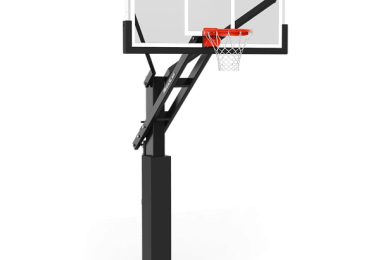
- The hoop post — an in-ground hoop (e.g. MegaSlam) set in a concrete footing is treated as a garden accessory structure (Nebenanlage). In most states, single sports accessory structures of limited height on private residential property are permit-free.
---
What May Require a Permit
Tall fencing
Perimeter fencing above approximately 1.5–2 m (the exact threshold varies by Bundesland and distance from property boundary) will typically require a permit. If you want a full ball-stop enclosure at height, factor this into your planning.
Floodlighting
Dedicated court floodlights — especially mast-mounted lighting above 3 m — are often considered a structure requiring a permit. The Game Light accessory (hoop-mounted LED spotlight, part of the hoop system) does not require a permit as it is integral to the hoop structure. Standalone lighting masts on separate footings are a different matter.
Conservation and protected areas
If your property is in or adjacent to a Naturschutzgebiet (nature reserve), Landschaftsschutzgebiet (landscape protection area), Wasserschutzgebiet (water protection zone), or a conservation area under a Bebauungsplan restriction, different rules apply. Consult your local Untere Naturschutzbehörde.
Listed buildings (Denkmalschutz)
If your property is listed (denkmalgeschützt), any significant change to the grounds may require approval from the Denkmalschutzbehörde. Consult your local authority before starting work.
Homeowner associations (WEG)
If you live in a managed estate or within a Wohnungseigentümergemeinschaft (WEG), the estate rules (Gemeinschaftsordnung) may have their own restrictions on garden modifications regardless of public building law. Check your WEG rules first.
---
The Versiegelung Question
Germany has growing regulation around impervious surface coverage (Versiegelung) in gardens. Some municipalities limit how much of a garden can be sealed against water infiltration, set via the Bebauungsplan or local bylaws.
This matters for basketball courts because:
- A standard concrete slab is fully impervious
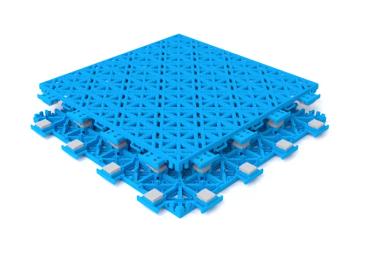
- Super X tiles have drainage channels through each tile — the surface is partially permeable. In many cases, a Super X court may not be counted as a fully sealed surface, which helps in municipalities with Versiegelung limits.
- Dynamic Pro II tiles are closed-surface and more likely to be treated as a sealed surface
If your municipality has Versiegelung limits, or your property is in a flood-risk zone (Überschwemmungsgebiet), check with the local Tiefbauamt or Wasserwirtschaftsamt before installing.
---
How to Check Your Specific Situation
- Look up your Bebauungsplan — the local development plan, publicly available on your Gemeinde or Stadt website. Check for any sporting, surface, or garden use restrictions.
- Check your state’s LBO — the relevant sections on Verfahrensfreiheit and Nebenanlagen. Most state LBOs are available online.
- Enquire at your local Bauordnungsamt — a brief written enquiry asking whether your planned court needs approval typically gets a response within 1–2 weeks. This costs nothing.
- Check WEG rules if applicable.
For the vast majority of standard residential garden courts — a tiled surface on an existing or newly prepared base, a single in-ground hoop, and fencing not exceeding the permit-free threshold — no permit is required.
---
State-by-State Summary
The rules vary in detail but the direction is consistent. The following is a general guide — always verify against the current version of your state’s LBO:
| Bundesland | Permit-free fence height (general) | Notes |
|---|---|---|
| Bayern | Up to 2 m (not adjacent to public road) | Separate rules for Landschaftsschutz areas |
| Baden-Württemberg | Up to 1.8 m (from boundary) | |
| Nordrhein-Westfalen | Up to 2 m | |
| Hessen | Up to 1.5 m | |
| Niedersachsen | Up to 1.8 m | |
| Berlin | Up to 1.5 m (residential zones) | Urban density rules apply |
| Hamburg | Up to 1.5 m | |
| Brandenburg | Up to 1.8 m | |
| Sachsen | Up to 1.8 m | |
| Thüringen | Up to 1.5 m | |
| Sachsen-Anhalt | Up to 1.8 m | |
| Mecklenburg-Vorpommern | Up to 1.8 m | |
| Bremen | Up to 1.8 m | |
| Schleswig-Holstein | Up to 1.5 m | |
| Rheinland-Pfalz | Up to 1.8 m | |
| Saarland | Up to 1.5 m |
Note: these are general indicative values for standard residential garden fencing. Actual rules depend on zone type, distance from road and boundary, and other site-specific factors. Verify with your local Bauordnungsamt.
The court surface and in-ground hoop are permit-free in all states.
---
Quick Reference Table
| Element | Typical permit status |
|---|---|
| Tile court surface (Super X or Dynamic Pro II) | No permit required |
| Concrete base preparation | No permit required |
| In-ground hoop (e.g. MegaSlam) | No permit required |
| Fencing up to ~1.5 m | No permit required in most states |
| Fencing 1.5–2 m | May require permit — check local LBO |
| Fencing above 2 m | Usually requires permit |
| Hoop-mounted LED lighting (Game Light) | No permit required |
| Dedicated floodlight masts | Usually requires permit |
| Court in nature reserve or protected area | Check with Naturschutzbehörde |
| Listed property (Denkmalschutz) | Check with Denkmalschutzbehörde |
---
If You Do Need a Permit
A formal Baugenehmigungsantrag requires a site plan (Lageplan) with the court marked, dimensioned drawings of the court and any structures, and a material description (Baubeschreibung).
OnCourt’s technical documentation pack (included with every order) contains dimensioned drawings and material specifications you can use directly in a permit application.
Related products
Frequently asked questions
View all FAQs →More questions? Browse the full basketball court FAQ