

Do You Need Planning Permission for a Basketball Court in Your Garden in Spain?
A private garden court in Spain is usually an obra menor, which means a declaración responsable rather than a full licencia. Planning sits with the municipality, so this covers what pushes you into the heavier route.
Do You Need Planning Permission for a Basketball Court in Your Garden in Spain?
This guide is general information, not planning or legal advice. Planning in Spain is administered by each municipality, so the same court can be handled differently in two neighbouring towns, and the PGOU or municipal ordinances that apply to your plot are the document that decides it. Ask the oficina técnica at your ayuntamiento about your address before starting work.
In most cases: no. A private basketball court in a residential garden is typically classified as a minor work (obra menor) in Spain and does not require a full planning licence. In many municipalities it falls under declaración responsable or comunicación previa — a simple notification — or is exempt entirely.
Spanish planning law is administered at municipal level, so rules vary by ayuntamiento. The information below explains how the system usually works, what can trigger extra requirements, and when it is worth checking locally.
---
How Spanish Planning Law Works
Planning in Spain is primarily a municipal competence. Each municipality applies its own Plan General de Ordenación Urbana (PGOU) or equivalent urban plan, within the framework of the relevant Comunidad Autónoma’s urbanismo law.
There is no single national rule — what applies in Madrid may differ from Valencia or Sevilla — but most municipalities use similar categories for outdoor residential works.
The three-tier system
Most Spanish municipalities classify works into three broad categories:
| Category | Description | Typical requirement |
|---|---|---|
| **Obra mayor** | Significant structural works (extensions, new buildings, major alterations) | Full **licencia urbanística** |
| **Obra menor** | Minor works with limited structural impact (small slabs, paving, low walls) | **Declaración responsable** or **licencia menor** |
| **Actuación comunicada / comunicación previa** | Very minor works (simple maintenance, small non-structural changes) | Simple **notification**, no prior approval |
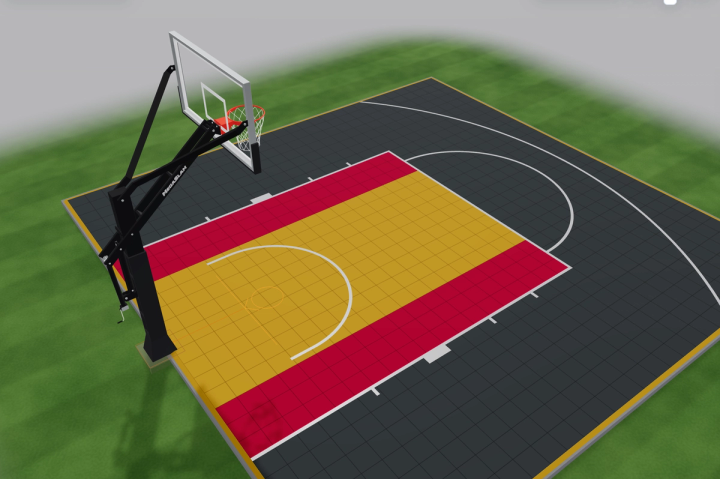
A garden basketball court — tiles on a concrete base, no roof, no permanent building — typically falls into obra menor or comunicación previa territory.
---
What Usually Does Not Require a Full Licence
The following characteristics usually mean a simpler procedure or exemption in most Spanish municipalities:
- Low or no fencing (commonly under 2 m)
- No roofed structure attached to the court
- Purely residential use (not commercial, club or rental facility)
- Within the existing building envelope of the property
- No change of use of the plot (it remains residential garden/yard)
A modular tile basketball court on a concrete slab, without tall fencing or permanent lighting structures, is generally treated as minor works.
---
What Can Require More
1. Fencing
Fencing is the most common trigger for extra paperwork.
- Fences under around 2 m: often fall under declaración responsable or simple comunicación previa.
- Fences over around 2 m: frequently treated as a structure that needs a licencia menor.
The exact height limit and process are set in your local PGOU or municipal ordinances, so it is worth confirming with the oficina técnica municipal.
2. Floodlighting
- Low mast lighting for a private garden court usually does not need separate planning permission, but the electrical installation must comply with regulations and be carried out or certified by a qualified electrician.
- High masts or commercial‑intensity lighting can trigger additional requirements or restrictions, especially regarding light pollution and neighbour impact. In these cases, check with your ayuntamiento before installing.
3. Surface sealing (impermeabilización)
Some municipalities regulate how much of a plot can be covered with impermeable surfaces (e.g. solid concrete) for drainage and flood‑risk reasons.
- A standard concrete slab may count towards your impermeable surface allowance.
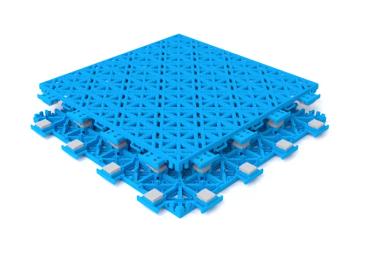
- OnCourt Super X tiles have a perforated frame that allows water to drain through to the base, which can be helpful to mention if the municipality asks about drainage.
- Designing the base with a gentle slope and appropriate drainage away from boundaries further reduces concerns.
4. Comunidad de propietarios (residents’ association)
If your property is part of a comunidad de propietarios (shared ownership community, urbanisation, apartment complex, etc.):
- You may need community approval for works, even if the municipality does not require a licence.
- This is especially relevant for terraced houses, villa complexes and urbanisations with shared or visually exposed areas.
Always check your community statutes and speak to the president or administrator before starting.
5. Protected buildings or conservation zones
If your property is:
- Listed as a Bien de Interés Cultural (BIC), or
- Located in a protected urban or landscape zone,
then any exterior works, including garden improvements, may require prior consent from the heritage authority or special municipal departments.
---
ICIO: The Works Tax
Most municipalities charge ICIO (Impuesto sobre Construcciones, Instalaciones y Obras) on construction works, regardless of whether a full planning licence is required.
- Calculated as a percentage (typically 3–4%) of the declared cost of the works.
- Declared and paid at the same time as you submit any licencia, declaración responsable or comunicación previa.
Even for small projects, some ayuntamientos will ask for an ICIO declaration.
---
Quick Reference Table
Related products

Frequently asked questions
View all FAQs →More questions? Browse the full basketball court FAQ