

Do you need permission for a garden basketball court in Italy?
A removable court on paving you already have is usually edilizia libera — no permission at all. What pushes it up to CILA, SCIA or a full permit, the vincoli that override all of it, and the condominio question people forget.
This guide is general information, not planning or legal advice. Italian building law is national in outline and municipal in practice: the regolamento edilizio and the local plan almost always decide the answer, and they differ from one comune to the next. Confirm with your Sportello Unico per l'Edilizia — the SUE — before starting work.
The short answer is that a removable modular court laid on paving you already have is usually edilizia libera — no permission at all. Everything harder than that depends on what you fix to the ground and where the property sits.
The four regimes
Italian building work is classified by the Testo Unico dell'Edilizia, DPR 380/2001, into four authorisation levels. Knowing which one your court falls into is the whole question.
| Regime | What it is | Typical court case |
|---|---|---|
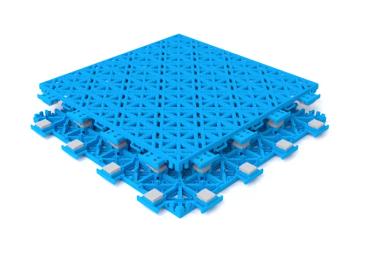
| **Edilizia libera** | No authorisation, under art. 6 | Removable modular tiles laid on existing paving; often a single in-ground hoop as *arredo esterno pertinenziale* |
| **CILA** | *Comunicazione di inizio lavori asseverata* — a certified notice for minor works | Tiles on bare ground where the *comune* treats it as new external works; fencing |
| **SCIA** | *Segnalazione certificata di inizio attività*, for more significant works | New fixed paving — concrete, asphalt, *autobloccanti* — and larger fixed structures |
| **Permesso di costruire** | A full building permit | Rare privately: permanent covers, substantial stands, major reshaping of the ground |
Two things follow. Reversibility is the hinge: tiles that clip together dry and can be lifted are treated far more leniently than a poured slab, because they are not a permanent transformation of the ground. And *the comune can be stricter than the national framework — many define manufatto leggero or arredo esterno* more narrowly than DPR 380/2001 does, and where they do, their definition governs.
What tends to push a court up a level
- A new fixed base. Concrete, asphalt or block paving is new pavimentazione, and that is normally CILA or SCIA territory even where the tiles alone would not have been.
- Fencing. Anything much above a metre commonly needs CILA or SCIA. Ask about it separately from the court — the answers are often different.
- Fixed structures. A low wall, a small stand, a permanent cover.
The constraints that override everything
Before deciding whether the works are free, check whether the property carries a vincolo. These sit above the ordinary regime, and where one applies the exemptions fall away.
Vincolo paesaggistico (D.Lgs. 42/2004). If the plot is landscape-protected you need autorizzazione paesaggistica before any building formality, and it bites on things that are not structural at all — colours, materials, fencing, even the hoop. This is the one most often discovered late.
Historic centre or artistic constraint. Expect prescriptions on materials, colours and reversibility. Removable modular tiles are usually the easier case to argue precisely because they can be taken up again.
Vincolo idrogeologico / PAI. New impermeable surface can require additional authorisation in hydrogeologically constrained areas. Open-grid draining tiles are generally regarded as lower impact than a sealed slab, which can matter to the outcome as well as to the drainage.
*PRG or PGT, and the regolamento edilizio. The local plan sets the numbers: minimum distances from boundaries — typically 1.5 to 3 m for fixed structures — and the indice di copertura, which fixed impermeable paving usually increases. The garden also has to be a residential pertinenza*.
You can check most constraints yourself at vincoli.beniculturali.it, and download the PRG/PGT and regolamento edilizio from the comune's own site.
If the court is in a condominio
This is a separate question from planning and catches people out.
- On common ground, an innovazione needs a resolution of the assemblea under art. 1136 of the Civil Code, at a qualified majority.
- In a garden you own exclusively, assembly approval is normally not required — but read the regolamento condominiale, which may restrict noise, hours of use, or visible structures regardless of what building law permits.
The procedure
1. Check the constraints — vincoli, PRG/PGT, boundary distances, coverage index.
2. Engage a qualified professional. A geometra, architetto or ingegnere is mandatory for CILA, SCIA and a permesso di costruire, and they are the person who determines which regime applies.
3. File with the SUE. CILA and SCIA are filed electronically and work can begin immediately on submission. A permesso di costruire has to be granted before anything starts.
4. Close the works — some cases require a comunicazione di fine lavori and a collaudo.
Indicative costs and timings
| Regime | Cost | Time |
|---|---|---|
| Edilizia libera | No administrative cost | None — begin immediately |
| CILA | ~€500–1,500 professional fee, plus municipal charges | Start on filing; allow 1–2 weeks for the paperwork |
| SCIA | ~€1,000–3,000 including charges | Start on filing |
| Permesso di costruire | ~€2,000–8,000+, including the *contributo di costruzione* | **60–90 days** from a complete application |
Budget the time rather than the fee. On a private court the professional fee is a small share of the build, and the permit route is what decides whether you are laying tiles this month or next season.
If it is already built
Removable modular tiles usually sit inside edilizia libera, so the exposure is limited. Fixed works carried out without a title may be regularised under art. 36 DPR 380/2001, but only where there is doppia conformità — the works must comply both with the rules in force when they were built and with those in force when the application is made. That is a judgement for a qualified professional, not a form to fill in.
Before you start
- Ask the SUE two questions, not one: what does the court need, and what does the fencing need?
- Check `vincoli.beniculturali.it` before anything else — a vincolo paesaggistico changes the whole route.
- Read the regolamento edilizio for boundary distances and the coverage index.
- In a condominio, establish whether the ground is common or exclusively yours before you design anything.
- If you can lay tiles on sound existing paving, you are very probably in edilizia libera — and that is also the cheapest court to build.
Costs, including the permit fees above in context: what a basketball court costs in Italy.
Relaterade produkter
Vanliga frågor
Visa alla vanliga frågor →Fler frågor? Bläddra bland alla vanliga frågor om basketplan