

Trenger du byggetillatelse for en basketballbane i hagen din i Frankrike?
Om en basketbane i hagen krever søknad, avhenger av tre ting: arealet, høyden på det du setter opp, og hvor eiendommen ligger. De fleste private baner krever på det meste en déclaration préalable.
This guide is general information, not planning or legal advice. French planning is administered locally: the Plan Local d'Urbanisme that applies to your plot is what decides the answer, and it differs from one commune to the next. Confirm with your mairie before starting work.
Most garden basketball courts in France need no permit for the court itself. That surprises people, and it is worth understanding why — because the things that do need paperwork are usually the ones added around the court, not the playing surface.
Why the surface itself is usually exempt
French planning is concerned with constructions. It measures them two ways: surface de plancher (enclosed floor area, under a roof, over 1.80 m of headroom) and emprise au sol (the footprint a structure occupies on the ground).
A flat sports surface laid at ground level creates neither. It has no roof and no walls, so there is no surface de plancher, and a surface that sits flush with the ground is not generally treated as emprise au sol. In practice a court is handled like a terrasse de plain-pied — a ground-level terrace — which is one of the works French planning leaves alone, provided it is not raised significantly above the natural ground level.
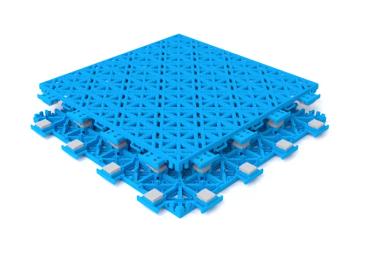
Modular tiles help here, because they lay directly onto a prepared base without adhesive and add only a few centimetres of height. A court that needed a raised deck, a retaining structure or substantial re-levelling of a sloping garden is a different proposition, and that is exactly the case to put to your mairie first.
What actually triggers paperwork
| What you add | Usual position | Why |
|---|---|---|
| The court surface, at ground level | No formality | Treated as a *terrasse de plain-pied* |
| Fencing or ball-stop netting | **Déclaration préalable, in many communes** | Communes may resolve to require a DP for all *clôtures* — a great many have |
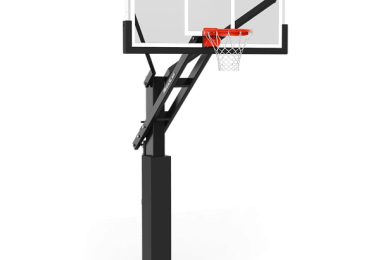
| A fixed hoop post | Usually no formality | Not an enclosed construction; height is what to check |
| Floodlighting | No planning formality, but rules apply | See *Lighting and noise* below |
| A raised or terraced platform | Likely a formality | It creates *emprise au sol* |
| Anything in a protected sector | **Formality, and an ABF opinion** | See below |
Fencing is the one that catches people out. A commune's conseil municipal can resolve to require a déclaration préalable for any clôture, and many have done exactly that. Ball-stop netting on posts is generally read as a clôture. Ask your mairie specifically about fencing — it is a separate question from the court, and the answer is often different.
Where you are matters more than what you build
Two local layers override the general position.
The PLU. Your commune's Plan Local d'Urbanisme is the document that actually decides. It can set a maximum emprise au sol for the plot, cap the proportion of the garden that may be made impermeable, impose minimum setbacks from the limites séparatives, and restrict materials or colours. A court that is exempt from a permit can still breach a PLU rule — those are two different tests, and both have to pass.
Protected sectors. If the property sits within the abords of a monument historique, in a site patrimonial remarquable, or in a site classé or inscrit, the ordinary exemptions fall away. Works that would need nothing elsewhere generally require a déclaration préalable, and the file goes to the Architecte des Bâtiments de France for an opinion that the mairie must follow. Surface colour and fence appearance become live questions rather than matters of taste. Instruction also takes longer — commonly two months rather than one.
Neighbours
Two French rules sit outside planning entirely and are not resolved by a permit.
Limites séparatives. The PLU sets minimum distances from boundaries. Even where the court itself is exempt, a fence, a lighting column or a hoop post near a boundary may not be.
Troubles anormaux de voisinage. French law recognises abnormal neighbourhood disturbance as its own head of liability. A permit — or an exemption — is not a defence to it. Ball noise against a fence, evening floodlighting into a bedroom window and repeated ball-overs are the three that generate complaints. Court orientation, a run-off margin that keeps play away from the boundary, and lighting aimed away from neighbouring windows are worth more than any paperwork.
Lighting and noise
Floodlighting a private court is not normally a planning matter, but France regulates outdoor lighting on its own terms. The arrêté of 27 December 2018 on nuisances lumineuses sets rules for outdoor lighting including sports facilities, covering how late lights may run and how much light may be thrown upward. Full-cutoff fittings aimed below the horizontal, and a timer, are the practical answer.
Noise is dealt with under bruits de voisinage rules, which are set locally by arrêté préfectoral or municipal order and typically define quiet hours. Check yours before committing to evening play.
The process, if you do need a déclaration préalable
- The form. A déclaration préalable for works at a single house is filed on the relevant Cerfa form, with a site plan, a plan of the works, and a photograph showing the setting.
- Where. At the mairie of the commune, or through the national online portal where the commune accepts it.
- How long. One month for instruction as a rule, extended to two months where an ABF opinion is required. Silence at the end of the period generally means tacit approval — but ask for the written confirmation, because you will want it when you sell.
- Display. Once granted, the decision must be displayed on site, visible from the public highway, throughout the works. Third parties then have two months from the start of that display to challenge it. The display is what starts that clock, so put the sign up promptly and photograph it.
- Validity. The authorisation runs for three years and can be extended.
Before you start
- Ask the mairie two questions, not one: does the court need a formality, and does the fencing?
- Read the PLU for emprise au sol, impermeability limits and boundary setbacks.
- Check whether the address falls within the abords of a listed monument or a protected site.
- Settle orientation and the run-off margin early — they do more for neighbour relations than anything on a form.
- Keep the written decision, and a photograph of the site display, with the house papers.
Relaterte produkter
Ofte stilte spørsmål
Se alle spørsmål og svar →Flere spørsmål? Bla gjennom hele FAQ-en for basketballbaner