

Basketball court cost in the Netherlands
From about €2,600 on existing paving to €26,000 built from new. Soft subsoil and a high water table make the base the biggest line — and a court counts as verharding, which many gemeenten now regulate.
A modular basketball court in the Netherlands runs from about €2,600 for a key court on existing paving to €26,000 for a garden half court built from new. Tiles and hoops are catalogue prices, the same in Groningen as in Maastricht. What varies is the grondwerk — and in the Netherlands that means two things almost nowhere else has to think about: what the ground will carry, and where the rainwater goes.
Figures exclude btw unless stated, which is how a prijsopgave to a business will read.
What the surface and equipment cost
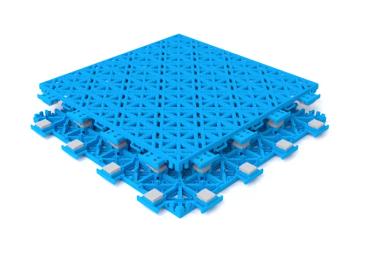
Tiles are €35–55 per m², Super X at the lower end and Dynamic Pro II at the upper.
| Court | Area | Tiles only |
|---|---|---|
| Compact key court, 6.11 × 6.72 m | ~41 m² | €1,450–2,300 |
| Extended key court, 5.3 × 9.4 m | ~50 m² | €1,750–2,750 |
| FIBA 3x3 court, 15 × 11 m | ~165 m² | €5,800–9,100 |
| NBA-spec half court, 15.2 × 14.3 m | ~217 m² | €7,600–11,900 |
| Full FIBA court, 28 × 15 m | ~420 m² | €14,700–23,100 |
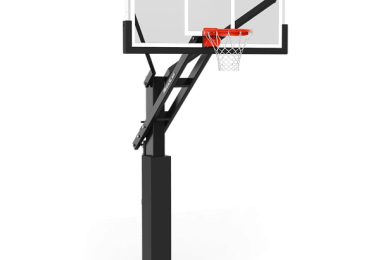
A MegaSlam 60 in-ground hoop is €2,900–3,800, a 72" board €4,100–5,300, a hoop-mounted light €950–1,400, a ball-stop net €470–820, and fencing €1,700–4,600.
Groundworks — soft ground and standing water
Reckon on €55–105 per m² for a base supplied and installed, which is at the upper end of Europe. The Randstad sits at the top; the east and south are cheaper.
Two Dutch conditions drive it.
Soft subsoil. Large parts of the country sit on peat and soft clay, which settle. A slab laid straight onto peat will move, and a court that moves opens joints. The normal answer is a properly compacted stabilised sand bed (zandbed) under the slab, and on genuinely poor ground the engineering goes further than that. A soil check before you price anything is cheap insurance — the difference between a good base and a bad one is invisible until the second winter.
A high water table. Drainage is not an afterthought here. Modular tiles help, because an open-grid tile drains through rather than shedding to an edge, but the base still has to let water go somewhere.
For a 165 m² 3x3 court, budget €9,100–17,300 for the base — frequently more than everything laid on top of it.
If you already have sound, level paving or concrete, tiles go straight over it and this whole section disappears from your quote. On a typical Dutch plot that is the single largest saving available.
Rainwater and hard surface — check before you buy
This is the Dutch-specific trap. A court is verharding — hard surface — and many municipalities now regulate it.
- A growing number of gemeenten require rainwater to infiltrate on your own plot rather than run to the sewer, under a local hemelwaterverordening. That can mean an infiltration crate or gravel reservoir under or beside the court, which is a real line on the quote.
- Some municipalities and waterschappen run the policy in the opposite direction too, with subsidies for removing paving and greening a garden. Adding 165 m² of hard surface may forfeit a scheme you would otherwise qualify for, and in some places it affects local levies.
Neither is expensive to design around and both are expensive to discover afterwards. Ask the gemeente two questions before ordering: does this need a permit, and does the rainwater have to stay on the plot?
btw
Standard btw is 21% — the highest of the major markets in this comparison. A €20,000 build carries about €4,200 of tax. Consumer prices normally include it and business quotes normally exclude it, so confirm which before comparing two numbers.
The reduced 9% rate covers certain work on homes more than two years old but does not extend to garden sports surfaces. Ask rather than assume.
Permission
A ground-level court is usually vergunningvrij under the Omgevingswet, and no omgevingsvergunning is needed for the surface. Fencing above a certain height, and anything in a protected setting, is where a permit appears. The detail is in the Dutch planning permission guide.
Frost depth is shallower here than in Germany, but a hoop footing still wants around 60 cm to be safe.
Three worked projects
Key court on existing paving — €2,600–4,400. Extended key court, sound existing surface, Super X tiles self-installed, wall-mounted hoop. No groundworks and no drainage question.
Garden half court — €16,000–26,000. 3x3 court, new base on a compacted sand bed, Dynamic Pro II tiles, in-ground MegaSlam 60. Well over half the total is below ground.
Club or school court — €24,000–40,000. NBA-spec half court, professional installation, 72" hoop, lighting and netting, shared-use markings. Clubs should ask the gemeente about sports-facility co-funding, which is common at municipal level and does not apply to private homes.
What tends to be left out
- Infiltration provision, where the gemeente requires it.
- Soil investigation, which is inexpensive and worth doing on peat or reclaimed ground.
- Reinstatement of lawn and planting.
- A duct for lighting, laid before the base — see the lighting guide.
Getting an accurate figure
Fix the specification in the 3D designer, settle the rainwater question with the gemeente, then tender the base locally with the drainage requirement stated in the enquiry. That last detail is what stops three quotes describing three different jobs.
Costs across the rest of Europe, and what drives the differences: what a basketball court costs in Europe.
Saistītie produkti
Bieži uzdotie jautājumi
Skatīt visus BUJ →Vēl jautājumi? Pārlūkot pilno basketbola laukuma BUJ