
A Practical Guide to Making the Right Flooring Decision
Choosing basketball court flooring is not about finding the “best” surface in absolute terms. It’s about selecting the right surface for how the court will actually be used, where it will live, and how much compromise you are willing to accept over time.
This guide is designed to help you think through those decisions clearly, before you start comparing products.
Start With the Environment, Not the Product
Indoor vs outdoor, tile vs poured, shock pads vs no shock pads. None of that matters until you define the environment the court will exist in. Flooring that performs brilliantly in one setting can be entirely wrong in another. The most common mistake people make is starting with a product comparison.
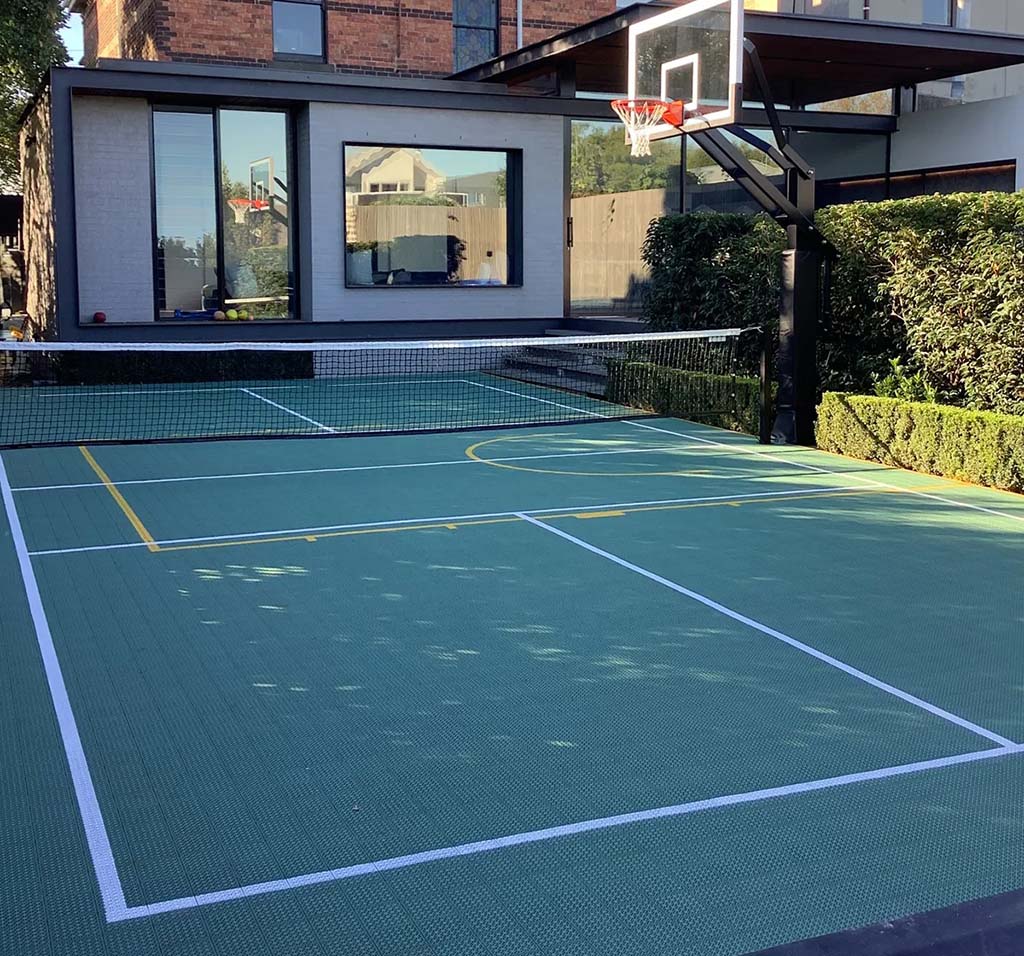
The first question should be a very simple one:
Is the court fully climate controlled, partially protected, or fully exposed?
If the answer isn’t “fully climate controlled all year,” then your flooring choice must prioritise durability and stability over ball-response alone. This single distinction eliminates a huge number of bad options immediately.
→ Related guide: Indoor vs Outdoor Basketball Court Flooring
Performance vs Comfort: Finding the Right Balance
Basketball flooring performance is often discussed as if it’s a single thing. It isn’t.
Performance can be measured by:
- Ball response
- Player grip
- Shock absorption
- Fatigue reduction
- Long-term consistency
You will rarely find all of these features at their maximum levels in one surface, especially outdoors.
For a private home court, performance may mean comfort and forgiveness.
For a school or shared facility, it may mean predictable behaviour and low maintenance.
For competitive play, it often means ball response and consistency, even at the expense of softness.
Indoor, Outdoor, and the Grey Area in Between
Indoor basketball flooring is designed to optimise play in controlled conditions. Outdoor flooring is designed to survive exposure without becoming unsafe or unstable.
The problem is that many courts sit between those two worlds.
Covered courts, carports, training barns, and partially enclosed spaces feel indoor — but behave like outdoor environments. Moisture, temperature changes, and condensation still affect the surface.
If a space is not sealed, heated, and humidity-controlled, it should be treated as outdoor when choosing basketball court flooring. This one decision prevents most long-term issues people experience.
Modular Tiles vs Poured Surfaces: A Decision, Not a Debate
There’s a lot of noise around surface types, but the real difference comes down to flexibility versus permanence.
Poured and coated surfaces are fixed systems. They can feel excellent when installed correctly, but repairs are disruptive and mistakes are expensive.
Concrete and Asphalt
Concrete and asphalt are structural bases, not performance surfaces. While playable, they:
- Offer no shock absorption
- Increase joint stress
- Can crack over time
Most high-quality basketball courts use concrete only as a sub-base beneath a sports surface.
بلاط رياضي معياري
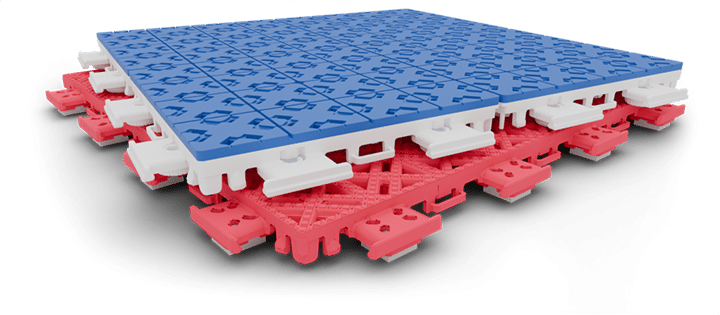
Modular tiles are widely used for modern basketball courts because they:
- Install over prepared sub-bases
- Handle thermal movement
- Deliver consistent performance
- Allow easy replacement or expansion
They are commonly used for both home and commercial outdoor courts.
Sprung Timber and Synthetic Indoor Floors
Indoor facilities often use sprung systems for elite play, but these are typically unsuitable for outdoor or mixed-use environments.
Related guide: خيارات أسطح ملاعب كرة السلة الخارجية

Durability, Maintenance, and Lifespan
Flooring is a long-term investment. Key considerations include:
- Resistance to wear in high-traffic areas
- Ease of cleaning and upkeep
- UV and weather resistance (outdoors)
- Ability to replace individual sections if damaged
Low-maintenance systems often provide the best lifetime value, even if the initial cost is higher.
Why Samples Matter Before You Decide
Flooring looks and feels very different in person than it does online. Ordering samples allows you to:
- Assess grip and texture
- Compare comfort underfoot
- See real colour tones
- Understand tile scale and proportions
Handling real materials removes guesswork and builds confidence before committing to a full court.
→ Explore: عينات من أرضيات ملاعب كرة السلة
Making the Final Decision
Choosing basketball court flooring isn’t about finding the “best” surface overall, it’s about finding the right surface for your space, usage, and goals.
Once you understand:
- Where the court will be used
- Who will play on it
- The balance between performance and comfort
- Long-term durability requirements
You’re ready to move from research to specification.
Explore flooring systems: أرضيات ملاعب كرة السلة
Next Steps
If you’re ready to narrow your options:
- Review flooring systems designed specifically for basketball
- Order a flooring sample pack to compare materials
- Edit in the 3D court designer to visualise layouts and dimensions
Each step brings you closer to a court that performs exactly as it should.

 English (UK)
  Български
  Čeština
  Dansk
Dansk  Deutsch
  Nederlands
  Español
  Eesti
Eesti  Français
  Ελληνικά
  Hrvatski
  Magyar
  Italiano
  Latviešu valoda
  Lietuvių kalba
  Norsk bokmål
  Português
  Polski
  Română
  Српски језик
  Slovenčina
  Slovenščina
  Suomi
Suomi  Svenska
  Türkçe
  العربية